In a strategic push to deepen its presence in India’s fast‑growing maritime market, German shipping major Hapag‑Lloyd has announced the inauguration of a weekly “Kandla Shuttle” service linking Kandla Port in Gujarat with key Middle East hubs. The service, scheduled to commence in late July 2025, comes on the back of Hapag‑Lloyd’s 40 percent stake in J M Baxi Ports & Logistics—a joint‑venture partnership that underpins terminal operations at Kandla and signals a long‑term commitment to India’s northwest port gateway.
Cementing a Strategic Partnership
In early 2023, Hapag‑Lloyd AG one of the world’s top five container‑shipping lines with a fleet of 299 vessels and a 2024 transport volume of 12.5 million TEU completed its acquisition of a 40 percent stake in J M Baxi Ports & Logistics Limited, a unit of Mumbai‑based J M Baxi Group. This equity investment not only gives Hapag‑Lloyd a governance role in terminal expansions at Kandla, but also aligns the global carrier’s “Strategy 2023” growth ambitions with India’s infrastructure build‑out. According to Hapag‑Lloyd CEO Rolf Habben Jansen, “Terminal and infrastructure investments are a crucial element of our strategic agenda, and India is one of our key growth markets.”
The New Kandla Shuttle Loop
Under the forthcoming service, a dedicated vessel will rotate weekly on the following port rotation:
Jebel Ali → Kandla → Jebel Ali → Shuaiba → Shuwaikh → Jebel Ali
Each sailing will offer approximately 550 TEU of lift capacity from Kandla, catering to outbound cargoes such as textiles, chemicals, and machinery, and inbound commodities including petrochemicals and consumer goods. By providing a predictable fixed day of departure, the loop is expected to reduce transshipment delays and bolster just‑in‑time supply chains for shippers between western India and the Gulf.

Why Kandla Matters
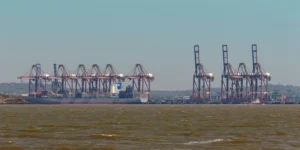
Kandla Port—officially renamed Deendayal Port in 2017—is India’s largest all‑weather tidal port on the west coast, handling over 132 million tonnes of cargo in FY 2023–24. Situated on the Gulf of Kutch some 90 km from open sea, Kandla serves as the primary gateway for bulk and container traffic destined for the hinterland of North, West, and Central India.
Historically eclipsed by deeper‑draft ports such as Nhava Sheva (Jawaharlal Nehru Port) and Mundra, Kandla has in recent years invested heavily in channel dredging, yard expansions, and digital terminal systems to reclaim market share. The arrival of a direct Gulf shuttle underscores both terminal operators’ confidence in sustained volume growth and Hapag‑Lloyd’s intent to diversify its Indian routing options beyond traditional hubs.
Benefits for Shippers and the Region
- Reduced Lead Times
Fixed‑day weekly departures cut out uncertainty associated with periodic feeder connections, trimming average transit times by 1–2 days for many cargoes. - Lower Transshipment Costs
By bypassing intermediate relay ports, the shuttle slashes handling charges and demurrage risks, particularly for small‑volume exporters in Gujarat’s industrial belt. - Infrastructure Leverage
Guaranteed vessel calls underwrite terminal capacity investments at Kandla, such as the ongoing expansion of refrigerated container racks and automated gate systems. - Trade Diversification
The service opens new direct access for India’s burgeoning exports of technical textiles, pharmaceuticals, and automotive parts to Gulf markets—segments that have seen double‑digit growth over the past two years.
Also read: MSC Rejects India’s $1.1 Billion Damage Claim, Refuses to Post Bond
Industry and Government Perspectives
- Hapag‑Lloyd: “Our joint‑venture with J M Baxi Ports & Logistics has always been about building local infrastructure in partnership with Indian stakeholders. The Kandla Shuttle is the natural next step,” said a spokesperson for the carrier.
- J M Baxi Group: Managing Director Sunil Baxi noted that “securing guaranteed vessel calls from a top‑tier liner like Hapag‑Lloyd will accelerate our plans for a third roro berth and hinterland rail connectivity.”
- Deendayal Port Authority: Chairman Sushil Kumar Singh remarked that the new service will “significantly ease vessel congestion and support steady import flows of critical commodities such as edible oils and fertilizers”.
The central government’s “PM Gati Shakti” framework, aimed at multimodal connectivity, has prioritized Kandla as a strategic node. Enhanced rail links to Gujarat’s industrial clusters and planned highway corridors to Rajasthan further sweeten the port’s proposition for global lines and cargo owners.
Competitive Landscape and Future Outlook
Hapag‑Lloyd is not alone in eyeing Kandla. Other international carriers, including CMA CGM and MSC, have increased calls at Kandla under ad‑hoc service schemes. However, none have committed to a dedicated shuttle with a fixed weekly rotation, giving Hapag‑Lloyd first‑mover advantage in the slot‑constrained container market.
Looking ahead, market watchers expect:
- Frequency Uplift: If cargo uptake exceeds projections, the weekly loop could ramp to bi‑weekly by mid‑2026.
- Network Extensions: Direct calls at emerging Gulf ports such as Sohar (Oman) or Khalifa Port (Abu Dhabi) could be added, broadening end‑market reach.
- Digital Integration: Collaboration with Indian rail and inland waterways operators for seamless door‑deliveries into India’s landlocked regions.
For Indian exporters grappling with global supply‑chain uncertainties—from Suez Canal congestion to spiraling freight rates—the Kandla Shuttle represents both a diversification opportunity and a bet on western India’s export resilience. As Hapag‑Lloyd leverages its global fleet and infrastructure stakes to carve out a niche at Kandla, India’s west coast stands poised to reclaim its role as the subcontinent’s gateway to the Gulf.
Source: (Hapag-Lloyd, The Economic Times, India Shipping News).