Introduction
In the wake of India’s ambitious maritime agenda, two important developments have emerged that highlight how the country is gearing up for rapid growth in the blue economy. On one hand, the Sagarmala Finance Corporation Limited (SMFCL) has approved a major borrowing plan to fuel investment across maritime infrastructure. On the other, the Indian Institute of Technology Guwahati (IIT Guwahati) in collaboration with the Indian Register of Shipping (IRS) has inaugurated advanced skill- and technology-programmes in underwater welding, offshore repair and additive manufacturing. Together, these two announcements reflect a dual-track strategy: build infrastructure and build human capital. This article walks you through both developments in detail, explains their significance for the maritime sector, and examines what they mean for students, maritime professionals, and industry watchers.
Financing the Maritime Infrastructure: SMFCL’s Big Move
What’s happening?
At its Annual General Meeting, SMFCL (a Mini-Ratna CPSE under the Ministry of Ports, Shipping and Waterways) approved an overall borrowing limit of ₹25,000 crore, out of which ₹8,000 crore is earmarked for the current financial year.
The funds will be mobilised through leading banks, financial institutions and bond issuances. SMFCL is also in discussions with major rating agencies, aiming for an apex scale rating to boost investor confidence and lower interest costs.
Why is this important for the maritime sector?
This is not just about lots of money, it signifies a structural push to strengthen the financing ecosystem of the maritime sector. SMFCL’s expanded role will cover:
- Ports and port-connectivity projects.
- Port-led industrialisation.
- Coastal community development.
- Coastal shipping and inland waterways.
- Particularly, vessel financing and shipbuilding.
This means the maritime infrastructure push is not just “more docks and berths” but encompasses upstream (industry), mid-chain (connectivity) and downstream (vessel / shipbuilding) components.
What are the implications for students and professionals?
- For those aiming at careers in maritime infrastructure, civil-engineering firms, shipping logistics, or inland waterways: the financing boost signals more projects, more procurement and more employment opportunities.
- For professionals in ship-building, vessel financing, maritime consultancy or port connectivity: this opens pathways for custom loan products (short-term, medium-term, long-term) as SMFCL intends to support these.
- For academia and researchers: the availability of institutional financing can spur applied research, project partnerships and curriculum aligned to port-connectivity, ship-finance and vessel design.
Key takeaways
- The borrowing limit of ₹25,000 crore is a strong indicator of priority and scale.
- The strategic vision covers entire value-chain in maritime infrastructure, not just isolated segments.
- Aiming for apex credit rating implies SMFCL wants to operate with institutional financial discipline and credibility.
- The focus on vessel financing and ship-building suggests India is serious about expanding its domestic ship-building capabilities.
Skill & Technology Drive: IIT Guwahati Launches Advanced Maritime Programmes
What’s happening?
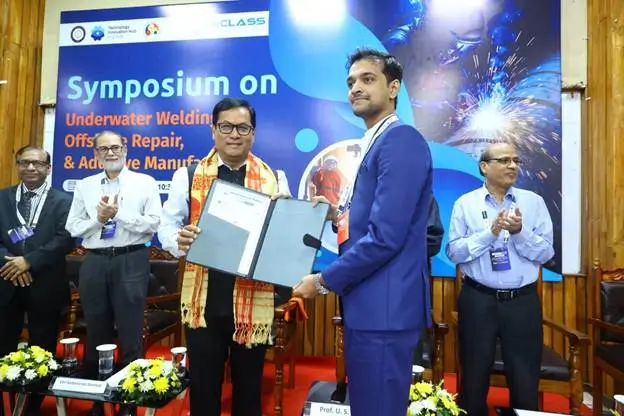
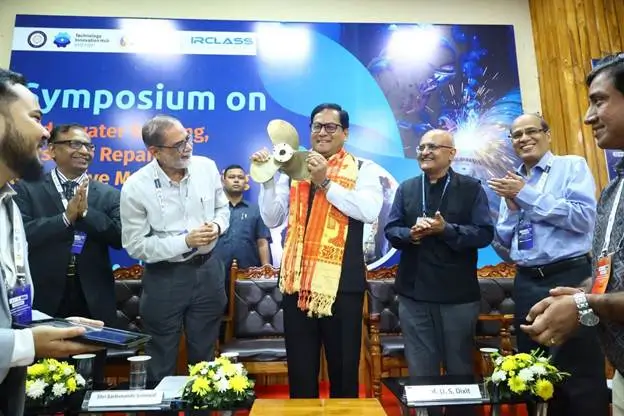
At an inaugural event on 22 November 2025, Sarbananda Sonowal, the Union Minister for Ports, Shipping & Waterways, launched a new initiative at the Technology Innovation Hub (TIH) of IIT Guwahati: programmes in underwater welding, offshore repair and additive manufacturing (3D printing) for maritime applications.
Seven youths completed the Underwater Welding Certification Programme supported by IRS and IIT Guwahati. A live demonstration of 3D metal-printing-based repair of a marine propeller was showcased.
Why is this significant for the maritime skills ecosystem?
- Underwater welding and offshore repair are highly specialised, in-demand skills in maritime operations, especially as India pushes ship-repair, offshore services and inland-water maritime infrastructure.
- Additive manufacturing (3D printing) of maritime components, such as a propeller repair, signals a move away from import-dependence and towards rapid, cost-effective in-house repair and retrofitting. The Minister noted that reliance on dry docking and imported components increased cost and delays; these technologies aim to reduce that.
- The choice of IIT Guwahati and focus on the Northeast highlights a geographic diversification of the maritime skills ecosystem, leveraging the region’s natural waterways and strategic potential.
What does it mean for students and professionals?
- Students interested in maritime engineering, offshore welding, additive manufacturing have a clear new pathway via IIT Guwahati’s TIH hub.
- Professionals in ship-yards, marine repair services, inland waterways can look to collaborate with the TIH, up-skill in underwater welding, repair technologies and 3D metal printing.
- Maritime industry employers should note the potential pipeline of certified skilled workers coming out of such programmes, which can reduce training lead-time and cost.
- For the region (the Northeast), this sets a precedent for regional hubs of maritime skills, which may lead to regional employment clusters and new maritime ecosystem development.
Key takeaways
- The inauguration signals the government’s focus on skills plus technology in the maritime sector, not just infrastructure.
- The partnership between academia (IIT Guwahati) and industry/standards body (IRS) is crucial: certification, live demos, applicability.
- The geographic emphasis on the Northeast indicates that maritime growth is not just the coast-west/east mainstream ports: inland waterways, regional hubs matter.
- The technologies (underwater welding + additive manufacturing) are forward-looking and align with global trends for maritime repair & maintenance.
Connecting Both Strands: Infrastructure + Skills = Maritime Momentum
Putting together the two developments gives a clear broader picture for India’s maritime sector:
- Massive financing (through SMFCL) ensures that the needed capital for ports, connectivity, vessel financing, ship-building is available.
- Advanced skills and technology (through IIT Guwahati and partners) ensure that the human‐resource and technology side of the equation keeps pace.
- The synergy means: when port-connectivity projects are being rolled out, there will be both funding and skilled workforce / technology available to execute efficiently.
- For the maritime sector (ports, shipping, ship‐building, inland waterways), this marks a maturation: moving from the “build‐something somewhere” mode to “financed + skilled + regionally dispersed” mode.
- For students and maritime professionals, the dual message is loud: now is a good time to align skills and careers in this sector – because both funding and technology are being ramped.
Also read: DG Shipping Introduces New Form-1 for Uniform Verification at Immigration Points
What to Watch & What to Do
What to watch
- The rollout of the ₹8,000 crore tranche in the current financial year by SMFCL: which projects will get financed, in which states, with what structure.
- The credit‐rating outcome of SMFCL: if it secures apex scale rating, cost of capital will reduce and more Maritime infrastructure players may tap into SMFCL.
- The further expansion of programmes at IIT Guwahati TIH: how many more youth are certified, what new technology interventions are added (for example sensors, robotics in underwater repair, AI in additive manufacturing).
- Whether other regional hubs beyond the Northeast will emerge, leveraging this model.
- The impact on ship-building in India: does the vessel financing support translate into new ship‐yards or retrofit hubs.
What to do if you’re a student or maritime professional
- If you’re a student: consider specialisation in underwater welding, additive manufacturing, marine repair technology – particularly if you are studying engineering, maritime studies or related fields.
- If you’re a professional in maritime infrastructure, shipping logistics, inland waterways: keep an eye on SMFCL’s loan product announcements – there might be financing opportunities or partner opportunities.
- If you’re in a company offering maritime services: explore collaboration with IIT Guwahati TIH or IRS to up-skill your workforce; being ahead of the technology curve (3D printing of maritime parts, advanced underwater repair) will give competitive edge.
- If you are in a regional cluster (especially in the Northeast): understand the geographic push – waterways, offshore repair capabilities might bring jobs and investments to your region.
Conclusion
The maritime sector in India is at an inflection point. With major financial engines being turned on (via SMFCL) and cutting-edge skill/technology programmes being launched (via IIT Guwahati & IRS), we are seeing a shift from incremental growth to systemic capacity building. For students, maritime professionals, academics and industry players, this means the moment is ripe: the infrastructure will be there, the funding will be there, and the skilled workforce is being nurtured. Aligning with this momentum could lead to rewarding careers and business opportunities in port connectivity, ship‐building, vessel repair, inland waterways and maritime manufacturing.
The dual focus on maritime infrastructure and maritime skills suggests that India is not just building for today but building for the next generation of its blue economy and that’s something worth watching closely.
Source: PIB