Introduction
At the Samudra Utkarsh seminar, the Government of India made a strong call to global partners to collaborate with the country’s rapidly growing shipbuilding sector. Rajnath Singh, the Raksha Mantri, highlighted India’s transformation into a capable, confident, and innovation-driven maritime nation.
This event showcased India’s rising capacity to design, build, maintain, and export a wide range of vessels from advanced warships to commercial ships and scientific research platforms. The broader message was clear: India is ready to become a global maritime hub.
What is Samudra Utkarsh and Why It Matters
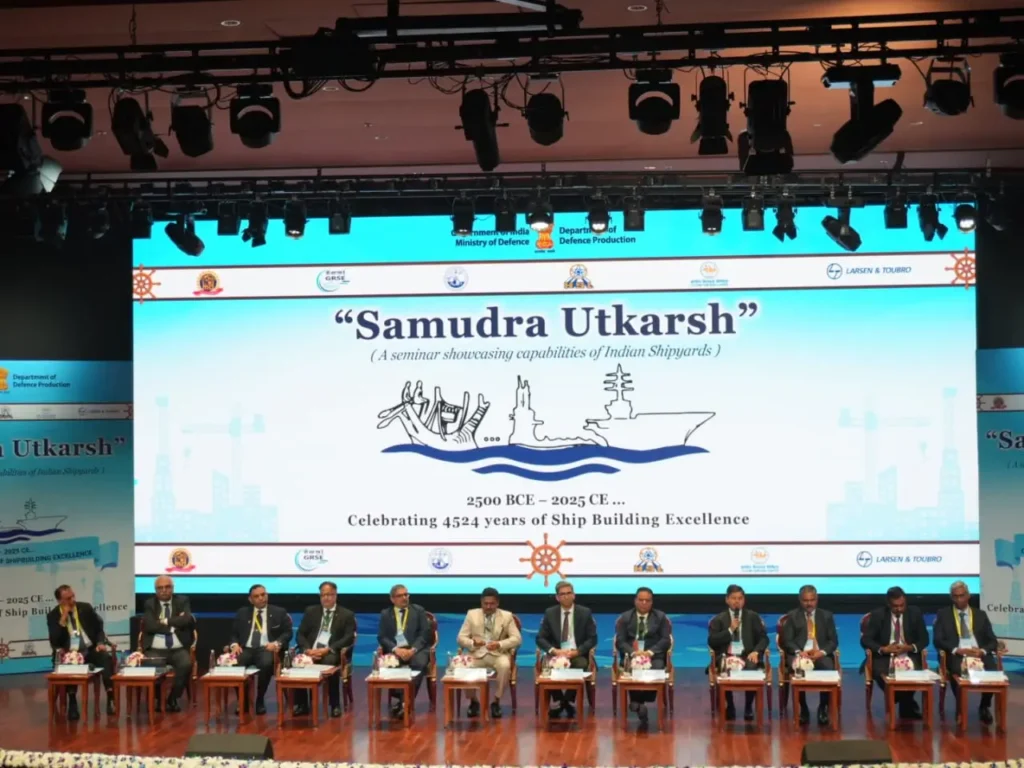
Samudra Utkarsh is a seminar organised by the Department of Defence Production to highlight India’s achievements and future goals in shipbuilding. Stakeholders from defence, commercial shipping, private shipyards, scientific institutions, and international industries came together to explore new opportunities. The government used this platform to convey that India’s shipbuilding ecosystem is strong, scalable, and prepared for global collaboration both in defence and commercial sectors.
Strength and Scope of the Indian Shipbuilding Industry
Complete Shipbuilding Ecosystem
Indian shipyards today offer end-to-end capabilities, including:
- Concept design
- Modular construction
- Outfitting and integration
- Repairs, refits, and upgrades
- Life-cycle support
A wide network of MSMEs supports the industry by supplying steel, propulsion systems, sensors, electronics, cables, and other ship components. This integrated ecosystem reduces dependence on imports and strengthens India’s industrial base.
Proven Success Across Multiple Segments
India has built:
- Indigenous aircraft carriers
- Advanced submarines
- Stealth frigates and destroyers
- High-end commercial vessels
- Research ships and survey vessels
- Pollution control vessels
- Deep-sea support ships
- High-speed ferries and coastal crafts
Private shipyards have added capabilities like LNG carriers, Ro-Ro vessels, green-fuel ships, and globally competitive commercial vessels. This clearly shows that India’s shipyards can design and build a wide range of platforms for multiple industries.
Growing Self-Reliance and Indigenous Content
A major highlight is that every warship and Coast Guard vessel currently under construction in India is being built domestically. Over 260+ indigenous design and development projects are already in advanced stages. Many shipyards aim to reach nearly 100% indigenous content within this decade. This marks a major shift toward self-reliance, supply-chain stability, and national security.
Why India Wants Global Collaboration
India invited international partners to collaborate on next-generation shipbuilding.
The goal is to combine:
- India’s expanding infrastructure
- Global innovation
- Green maritime technologies
- Joint manufacturing opportunities
- Shared R&D and digital shipbuilding
The collaboration extends beyond defence into:
- Commercial vessels
- Green-fuel ships
- Scientific research platforms
- Pollution-control vessels
- Dual-use maritime technologies
This opens possibilities for technology transfer, export partnerships, co-development, and global-standard production.
India’s Role in the Emerging Blue Economy
India’s push in shipbuilding supports the country’s larger Blue Economy vision.
How shipbuilding contributes:
- Boosts coastal shipping, trade, and connectivity
- Strengthens marine research through advanced vessels
- Supports sustainable ocean resource exploration
- Expands coastal and offshore employment
- Ensures environmental protection through green and pollution-control vessels
Shipbuilding becomes a major pillar of economic growth, innovation, and sustainability.
Also read: Gujarat Unveils Six New Maritime Policies to Strengthen Ports & Coast
Significance for Key Stakeholders
Defence & Security
- Indigenous vessels enhance strategic independence
- Large pipeline of naval and Coast Guard projects
- Strengthened readiness and maritime domain awareness
- Reduced dependence on foreign suppliers
Commercial Maritime Sector
- India is becoming cost-competitive for global ship orders
- Shipyards adopt digital processes and automation
- Improved capacity for repairs, retrofits, and maintenance
- Growth of green-fuel and LNG-ready vessels
Environment & Scientific Research
- More research ships improve ocean study and climate monitoring
- Pollution-control ships enhance coastal environmental protection
- Green vessels promote sustainable marine operations
MSMEs, Workforce & Innovation
- Thousands of MSMEs benefit from rising ship production
- New opportunities in robotics, AI, automation, and marine tech
- Increased demand for skilled workforce in manufacturing, design, and R&D
- Boost to entrepreneurship in marine equipment and digital shipyard tools
Challenges & What Lies Ahead
India’s growth path includes challenges such as:
- Building long-term global partnerships
- Meeting international classification standards
- Ensuring environmental compliance
- Strengthening supply chains and raw material sourcing
- Expanding skilled manpower and training
However, with strong political support, new reforms, and long-term planning, India is moving steadily toward becoming a major maritime powerhouse.
Conclusion
The message from Samudra Utkarsh signals a new era for Indian shipbuilding. India is no longer just a buyer of ships it is an emerging builder of world-class maritime platforms. With strong infrastructure, self-reliance, innovation, and a vibrant ecosystem of public and private shipyards, the country is ready to take centre stage in global shipbuilding.
Source: PIB