The Indian Coast Guard (ICG) convened a comprehensive national exercise off the coast of Chennai on October 5–6, 2025, combining the 10th National Level Pollution Response Exercise (NATPOLREX-X) with the 27th National Oil Spill Disaster Contingency Plan (NOSDCP) preparedness meeting — a focused push to sharpen the country’s oil spill response and marine pollution preparedness.
The biennial NATPOLREX-X, long established as a core component of India’s marine environmental protection posture, ran in parallel with the NOSDCP review. The combined event drew over 105 national delegates and 40 foreign observers representing 32 countries, creating a rare platform for international knowledge exchange on oil spill response tactics, command-and-control coordination and post-spill recovery strategies.
A standout feature of this edition was the first-ever shoreline cleanup drill at Chennai’s Marina Beach, carried out as part of the simulated incident. Local civic bodies — including the Greater Chennai Corporation, the State Pollution Control Board and State Disaster Management Authority — participated alongside police and other state agencies in a coordinated shore-level response. The Marina Beach drill underscored the reality that oil spill response is not limited to vessels and aircraft: shoreline operations, community mobilization and rapid debris management are critical to mitigating environmental and socio-economic impacts.
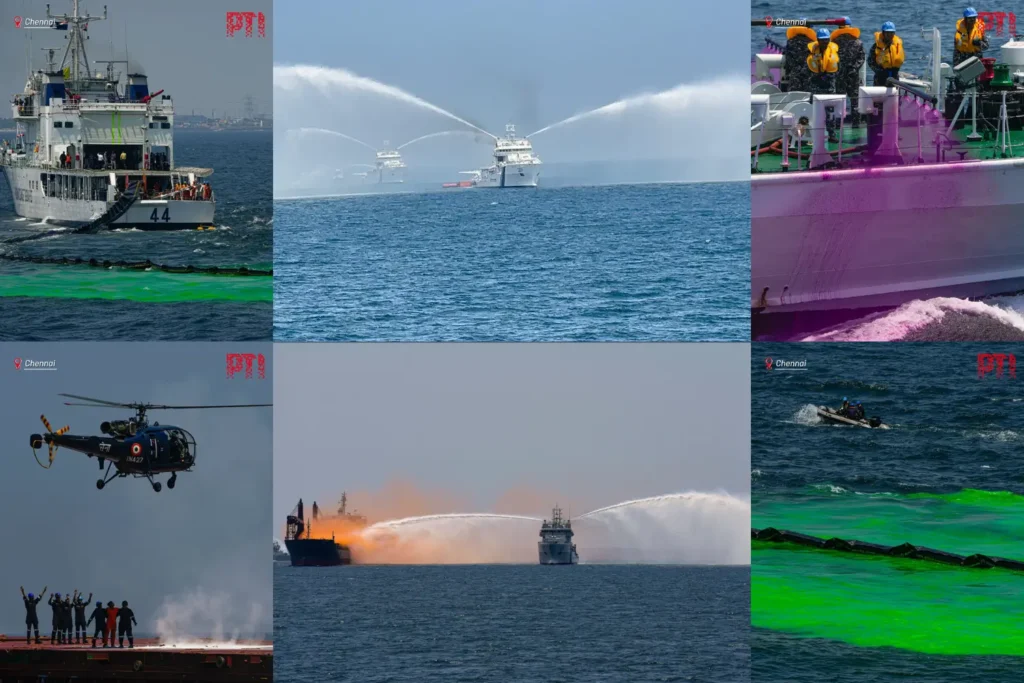
Operational demonstrations validated the ICG’s multi-layered pollution response framework. A range of domestic and indigenous platforms were deployed, from Pollution Control Vessels (PCVs) to Offshore Patrol Vessels (OPVs), Fast Patrol Vessels (FPVs), and aerial surveillance assets such as Chetak and Dornier aircraft configured for pollution monitoring and response. The visible use of homegrown assets aligns with India’s Make in India push and signals growing self-reliance in maritime pollution control capabilities.
Technical sessions ran alongside live drills and provided a forum for scientists, policy makers and operational experts to share lessons and research. Topics included the environmental impact of nurdle spills, case studies on Hazardous and Noxious Substances (HNS), post-spill environmental monitoring and impact assessment, and shoreline cleanup lessons learned from previous incidents such as the MV MSC ELSA 3 event. Those sessions are central to improving national oil spill response doctrines and ensuring that response plans reflect emerging contamination patterns and remediation science.
The NOSDCP — the National Oil Spill Disaster Contingency Plan drafted by the ICG and approved in 1993 — remains the foundational national framework guiding preparedness and inter-agency coordination. To operationalize the plan, the ICG maintains four Pollution Response Centres at Mumbai, Chennai, Port Blair and Vadinar, providing regional hubs for rapid mobilization, equipment staging and joint response planning. The Chennai exercise reinforced the role of the NOSDCP as the connective tissue between central ministries, coastal state governments, major ports, oil handling agencies and response organizations.

Why it matters: India depends on seaborne oil imports for more than three-quarters of its energy needs, making oil spill readiness a strategic priority. Exercises like NATPOLREX-X and the NOSDCP review strengthen practical command structures, test logistics chains, and expose gaps before a real incident occurs. Equally important, the international participation in this cycle helps harmonize response standards and encourages cross-border collaboration for transboundary pollution events.
Outcomes and next steps from the exercise highlighted several practical takeaways: improved shoreline clean-up protocols and inter-agency drills, wider adoption of indigenous pollution response assets, and expanded technical knowledge sharing on niche topics such as nurdle behavior and HNS response. The ICG’s leadership role as central coordinating authority for oil spill response remains pivotal, with these exercises acting as both a capability showcase and a learning crucible for India’s broader marine pollution preparedness goals.
In sum, NATPOLREX-X and the 27th NOSDCP off Chennai represent more than an exercise. They are a visible demonstration of the Indian Coast Guard’s evolving oil spill response architecture and a signal that India is investing in the operational, scientific and institutional pieces needed to protect its marine environment from open sea containment to the last metre of shoreline. As shipping volumes and coastal activity continue to rise, that layered preparedness will matter more with every passing year.
Source: (Press Information Bureau)