India Moves Closer to Atmanirbhar Container Ecosystem
India took a decisive step toward building a self-reliant container and shipping ecosystem with the signing of a key Memorandum of Understanding (MoU) for the establishment of the Bharat Container Shipping Line. The development marks a major milestone in the government’s Atmanirbhar container drive, aimed at reducing dependence on foreign shipping lines and strengthening India’s control over its export-import supply chains.
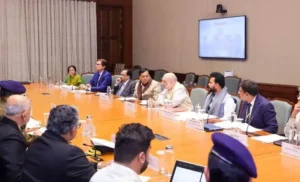
The MoU was signed in the presence of Sarbananda Sonowal, Union Minister of Ports, Shipping and Waterways, and Ashwini Vaishnaw, Union Minister for Railways, Information & Broadcasting, and Electronics & IT. The ceremony highlighted a coordinated national effort linking shipping, ports, railways, and logistics infrastructure.
Union Minister of State for Ports, Shipping and Waterways Shantanu Thakur was also present, reinforcing the government’s commitment to building a strong domestic maritime ecosystem.
Bharat Container Shipping Line – Strategic National Initiative
The MoU for the Bharat Container Shipping Line was signed by six key maritime and logistics institutions like Shipping Corporation of India, Container Corporation of India, Jawaharlal Nehru Port Authority, V.O. Chidambaranar Port Authority, Chennai Port Authority, and Sagarmala Finance Corporation Limited.
The agreement was executed under the aegis of the Ministry of Ports, Shipping and Waterways. The initiative is designed to anchor India’s container trade within Indian hands and align national shipping capacity with domestic port and logistics development.
This move directly supports the Atmanirbhar container drive and strengthens India’s ability to manage its own EXIM logistics without excessive exposure to global freight volatility.
Source: x.com/shipmin_india
Alignment with Container Manufacturing Assistance Scheme
The Bharat Container Shipping Line initiative aligns closely with the Container Manufacturing Assistance Scheme (CMAS) announced in Union Budget 2026–27. The scheme provides a ₹10,000-crore incentive framework to establish domestic container manufacturing capacity in India.
By linking container production with a national shipping line, the government aims to create a fully integrated container ecosystem covering manufacturing, shipping, port handling, and inland logistics. This integration is expected to reduce import dependence, stabilise freight costs, and improve supply-chain resilience.
The Atmanirbhar container drive is thus not limited to manufacturing alone but extends across the entire maritime and logistics value chain.
₹59,000-Crore Vision for Fleet and Containers
The national container line initiative is part of a broader vision involving a proposed ₹59,000-crore investment in fleet expansion and domestic container manufacturing. This investment is expected to anchor India’s long-term EXIM logistics strategy as trade volumes continue to rise.
India’s economy, currently ranked as the world’s fourth largest, is projected to grow to around $7.3 trillion by 2030. This growth trajectory will significantly increase containerised cargo traffic, placing additional pressure on ports, shipping lines, and logistics infrastructure.
The absence of a strong Indian container carrier in the past has exposed exporters and importers to volatile freight rates and global supply disruptions. The Bharat Container Shipping Line is expected to address this gap by offering stable, Indian-controlled shipping capacity.
Outer Harbour Expansion at VOCPA Gets Financing Boost
Alongside the BCSL MoU, a separate tripartite MoU was signed to finance the Outer Harbour Project at V.O. Chidambaranar Port Authority in Tuticorin. The agreement was executed between the port authority, Indian Railway Finance Corporation Limited, and Sagarmala Finance Corporation Limited.
The financing framework provides for joint funding of up to ₹15,000 crore for eligible port expansion projects under the Sagarmala Programme and the PM Gati Shakti National Master Plan. The focus is on enhancing maritime infrastructure to meet rising cargo demand.

Source: x.com/sarbanandsonwal
Hybrid Annuity Model for Port Development
The Outer Harbour financing will primarily support breakwater construction and related onshore and offshore facilities. Funding will be extended through a Hybrid Annuity Model (HAM), which balances public investment with long-term financial sustainability.
This model is expected to accelerate project execution while ensuring financial discipline. Enhanced port capacity at Tuticorin will strengthen India’s eastern and southern maritime gateways and improve connectivity with hinterland logistics networks.
Government’s Vision – Maritime Amrit Kaal 2047
Speaking on the occasion, Sarbananda Sonowal said the MoUs represent the translation of Prime Minister Narendra Modi’s Atmanirbhar Bharat vision into concrete maritime capability. He emphasised that the Bharat Container Shipping Line, combined with domestic container manufacturing, would anchor India’s container trade within the country.
According to Sonowal, the initiatives will play a multiplier role in enhancing India’s strategic and commercial presence in global maritime trade. They align with the long-term vision of Maritime Amrit Kaal 2047, which aims to make India a leading maritime nation by the centenary of independence.
Rail–Port–Shipping Coordination Strengthened
Ashwini Vaishnaw highlighted the importance of seamless coordination across ministries. He said the initiative ensures faster approvals, efficient execution, and strong integration between shipping lines, ports, and rail logistics.
He noted that the container line, developed in partnership with CONCOR, would help build a world-class container ecosystem with investments of around ₹15,000 crore. The initiative follows earlier reforms in shipbuilding financial assistance and ship recycling, marking another major step in maritime sector development.
Also Read: Budget 2026 Charts New Course for India’s Maritime Power
Leadership and Long-Term Impact
Shantanu Thakur described the MoUs as a demonstration of foresight and leadership in India’s maritime resurgence. He said the initiatives would strengthen India’s presence not only on land but also across global sea routes.
As containerised trade grows, the Atmanirbhar container drive is expected to protect Indian exporters and importers from external shocks while improving national control over logistics costs and reliability.
A Structural Shift in India’s EXIM Logistics
The signing of the BCSL MoU and the Outer Harbour financing agreement marks a structural shift in India’s EXIM logistics strategy. By combining domestic shipping capacity, container manufacturing, and modern maritime infrastructure, the government is laying the foundation for a resilient and self-reliant maritime ecosystem.
With coordinated action across ports, shipping, railways, and finance, India is positioning itself to meet future trade demands while reducing dependence on foreign carriers, an essential step in its journey toward becoming a global maritime leader.