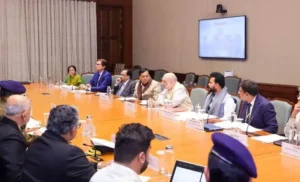
India’s maritime sector is witnessing a historic transformation as the Union Government under Prime Minister Narendra Modi pushes for a Viksit Bharat 2047, with a strong focus on shipbuilding, inland waterways, and port modernization. Union Minister of Ports, Shipping, and Waterways Sarbananda Sonowal emphasized the government’s comprehensive strategy, combining policy reforms, financial incentives, and infrastructure development to position India as a global maritime hub.
Driving Self-Reliance and Global Competitiveness
Responding to a question in the Lok Sabha, Sarbananda Sonowal highlighted that the Indian shipbuilding industry is undergoing a transformational shift. The Union Budget 2025 has allocated significant resources to boost the competitiveness of Indian shipyards under the Maritime India Vision 2030, aligned with the Amrit Kaal roadmap.
- Revamped Shipbuilding Financial Assistance Policy to offset cost disadvantages.
- Credit notes for ship-breaking to promote a circular maritime economy.
- ₹25,000 crore Maritime Development Fund, with 49% government contribution, to attract private and port-led investments.
- Infrastructure status for large ships, enabling long-term, low-interest financing.
- Tax exemptions on raw materials and components for shipbuilding extended for 10 more years.
Additionally, the Right of First Refusal (ROFR) has been extended to Indian shipyards for public sector contracts, reinforcing the Make in India initiative. The government also released five standardized tug designs to streamline procurement and promote efficiency in domestic shipbuilding. On the ship repair front, Cochin Shipyard Limited (CSL) inaugurated a ₹970 crore International Ship Repair Facility (ISRF) in Kochi, reducing India’s dependence on foreign repair docks and creating a regional maintenance hub.
Sonowal underlined that shipbuilding capability is vital not only for economic growth but also for strategic security, stating “India is not just building ships; we are building a resilient future. These reforms will unlock opportunities for investment, innovation, and global collaboration in the maritime sector.”
Strengthening India’s Eastern Maritime Corridor
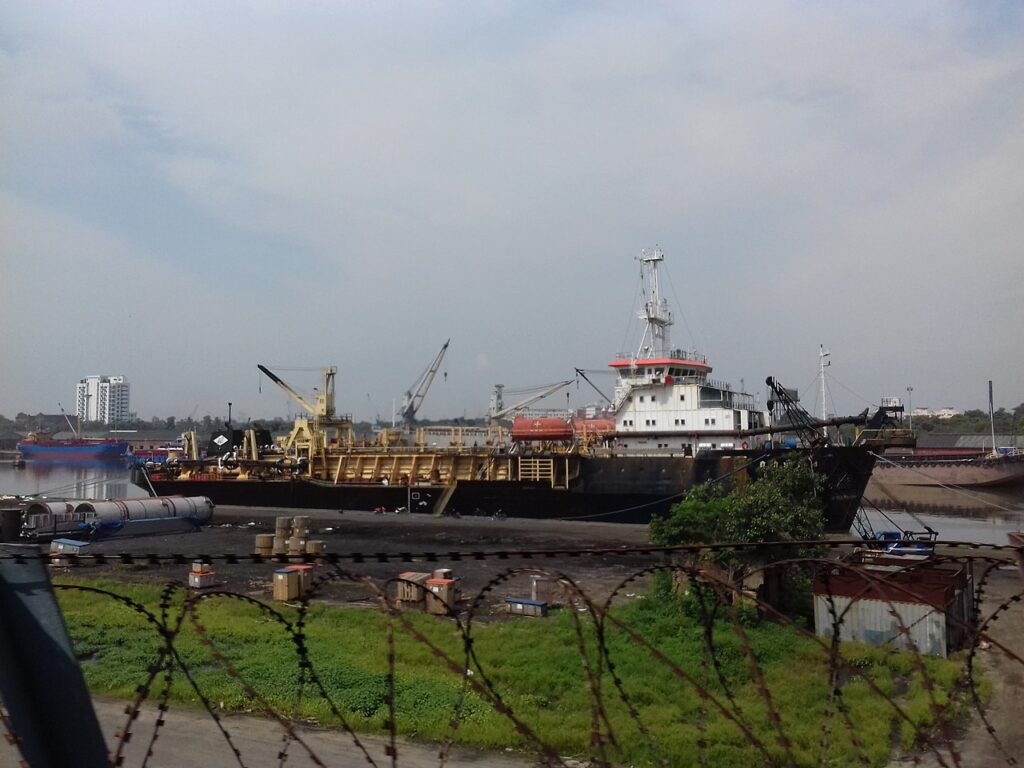
The Maritime India Vision 2030 identifies Chennai-Kamarajar-Cuddalore as a mega port cluster on the eastern coast, targeting 300 MTPA cargo handling capacity by 2047. Under the Sagarmala Programme, the government has launched 234 port modernization projects worth ₹2.91 lakh crore. Of these:
- 104 projects worth ₹32,654 crore have been completed.
- 55 projects worth ₹74,725 crore are under active implementation.
Modernization efforts are particularly focused on Chennai, Ennore (Kamarajar), and Tuticorin (VO Chidambaranar) ports, alongside enhanced rail and road connectivity to integrate ports with the PM Gati Shakti National Master Plan. Additionally, the government has issued Harit Sagar (Green Port) Guidelines, emphasizing carbon reduction and sustainable practices to align Indian ports with global environmental standards.
Unlocking Alternate Transport
A key pillar of India’s maritime growth is the inland water transport (IWT) sector, which promises cost-effective, eco-friendly cargo movement. The government sanctioned ₹6,833.46 crore in the last five years to enhance infrastructure along national waterways, with landmark projects including:
- Jal Marg Vikas Project (JMVP I & II) on NW-1 (Varanasi-Haldia) with ₹5,061 crore investment.
- Comprehensive development of NW-2 (River Brahmaputra) in Assam.
- Eight hybrid electric catamarans and one hydrogen-fueled vessel by Cochin Shipyard Limited.
- Construction of 60 community jetties to benefit farmers, fishermen, and local traders.
According to World Bank studies, inland water transport costs ₹1.2 per ton-km, making it highly competitive. In FY 2024-25, 4,229 vessels navigated NW-1, creating 1.3 lakh direct and indirect jobs and energizing the local economy along the Ganga-Bhagirathi-Hooghly river system.
Also read: Evergreen’s Ever Lunar Loses – 50 Containers Overboard off Callao Bay
Sagarmala Projects and Coastal Community Development
The Sagarmala Scheme continues to drive port-led development by leveraging India’s 7,500 km coastline and 14,500 km of navigable waterways.
- 121 projects worth ₹9,415 crore have been partially funded under Sagarmala.
- 77 projects have already been completed, ranging from fishing harbors to Ro-Pax ferry services, coastal berth projects, and skill development initiatives.
- Coastal community development and cruise terminal projects are opening new avenues for tourism and employment.
The Ministry has also adopted a third-party impact assessment mechanism, ensuring efficiency and accountability in project execution.
India’s Maritime Vision for Viksit Bharat 2047
By integrating shipbuilding, waterways, and ports modernization, India is strategically positioning itself to:
- Enhance export competitiveness through efficient logistics.
- Reduce transport costs via multimodal connectivity.
- Generate large-scale employment in shipbuilding, river transport, and coastal tourism.
- Achieve self-reliance in maritime assets, supporting both commercial and strategic interests.
As India accelerates its maritime journey, Sarbananda Sonowal reiterated that the maritime sector is central to Viksit Bharat 2047, stating that a robust ecosystem will “unlock investment, innovation, and sustainable economic growth for the nation.”
Source: (pib.gov.in)