On 6 October 2025, the Government of India marked a significant milestone in the country’s maritime journey: the induction of VLGC Shivalik under the Indian flag. This event welcomed by Union Minister Shri Sarbananda Sonowal at Visakhapatnam Port symbolises India’s commitment to maritime atmanirbharata (self-reliance in shipping). It also signals a push toward becoming a top-tier maritime nation by 2047, in line with the Maritime Amrit Kaal Vision 2047.
This detailed development has implications for India’s energy security, shipbuilding sector, foreign exchange savings, and national prestige in the global maritime domain.
What is VLGC Shivalik?
VLGC stands for Very Large Gas Carrier. The Shivalik is the third VLGC inducted into India’s Shipping Corporation of India Ltd. (SCI) fleet. It joins two others: Sahyadri and Anandamayi.
Some technical and operational highlights:
- Capacity: 82,000 cubic metres (CBM)
- Length: 225 metres
- Built in South Korea
- Features: segregated tanks, advanced temperature control, global safety & efficiency compliance
- Maiden voyage: Loaded over 46,000 metric tonnes of LPG (propane + butane) in Ruwais (UAE), then delivered to Visakhapatnam for Indian Oil Corporation Ltd. (IOCL)
By bringing Shivalik under Indian ownership and flag, the government underscores its increasing ambition in global energy trade and maritime presence.

Strategic Significance & National Goals
India imports significant quantities of LPG for domestic consumption. Having a VLGC like Shivalik under the Indian flag ensures safer, more reliable transportation of that fuel. It deepens energy connectivity with the Arabian Gulf, reducing dependence on foreign shipping lines.
The government aims for more Indian-flagged vessels carrying its cargo. Shivalik’s induction is a step toward that. Minister Sonowal framed it not merely as fleet expansion but as a confidence statement in India’s shipping resurgence and its capability to compete globally.
One of the bold claims: by 2047, joint ventures (JVs) between SCI and oil PSUs planning to build 112 vessels will save about $75 billion (₹6 trillion) in freight costs otherwise paid to foreign lines annually.
The government is concurrently pushing policies to stimulate domestic shipyards, repair, recycling, design, and financing. These will create high-quality employment, strengthen the supply base, and reduce cost disadvantages for Indian shipbuilders.
India as a holistic maritime ecosystem can design, build, finance, own, repair, recycle. – Sarbananda Sonowal
Under Prime Minister Modi’s leadership, the government is charting a course toward positioning India among the world’s top five maritime powers by 2047. The induction of Shivalik is portrayed as one tangible milestone in that trajectory.

Supporting Policy & Financial Measures
To enable this ambition, the government has rolled out several schemes, funds, and reforms –
| Scheme / Initiative | Outlay / Feature | Purpose / Impact |
| Comprehensive Package for Maritime & Shipbuilding | ₹69,725 crore | To accelerate shipbuilding, modernisation, competitiveness |
| Shipbuilding Financial Assistance Scheme (SBFAS) extension | ₹24,736 crore till 2036 | Supports Indian shipyards |
| Maritime Development Fund (MDF) | ₹25,000 crore (₹20,000 cr investment + ₹5,000 cr interest incentives) | Long-term financing, interest support |
| Shipbuilding Development Scheme (SbDS) | ₹19,989 crore | Expand domestic shipbuilding capacity (target: 4.5 million gross tonnage annually) |
| Infrastructure status & tax / duty incentives | — | Infrastructure status for large vessels; customs duty exemptions on components; extension of tonnage tax to inland vessels |
These initiatives aim to level the playing field for Indian shipyards, reduce cost handicaps, attract investments, and promote innovation in green shipping and recycling.
On-the-Ground
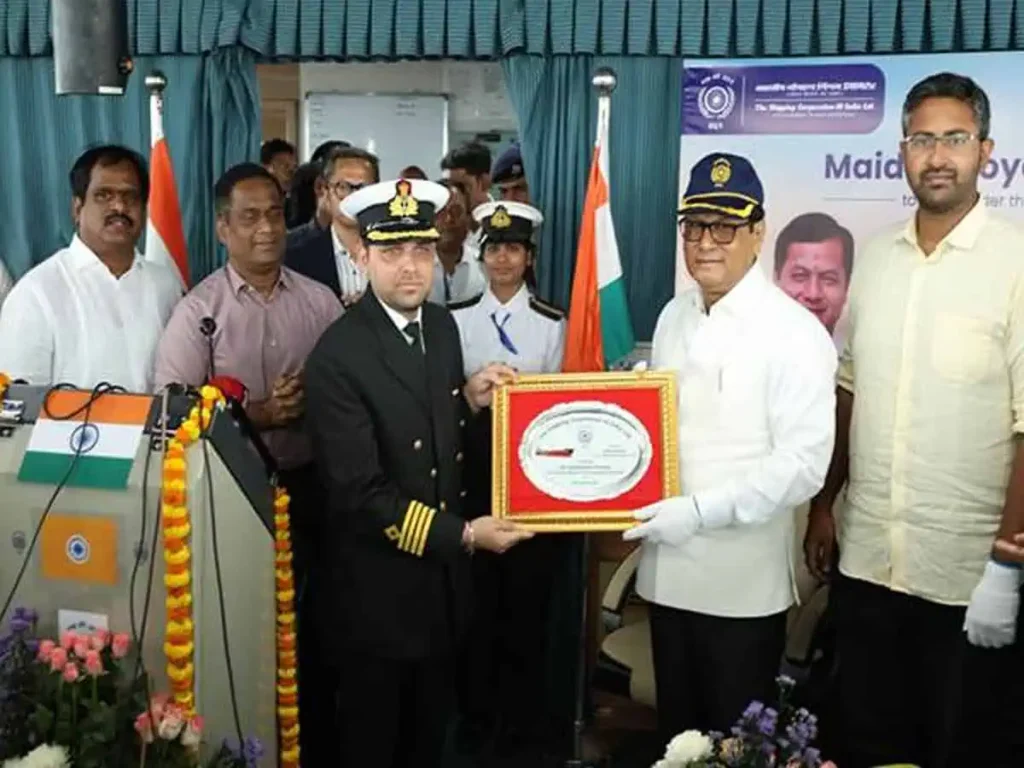
The event at Visakhapatnam saw a gathering of dignitaries:
- Union Minister Shri Sarbananda Sonowal
- Visakhapatnam MP and MLA
- Chairman of Visakhapatnam Port Authority
- SCI Chairman & Managing Director
- Capt. Bhaskar Tandon (Master of Shivalik) & other maritime officials
They toured critical parts of the vessel like navigational bridge, cargo control room guided by Capt. Tandon and Chief Officer Vivek Tyagi.
Sonowal addressed the 29-member crew, praising them as ambassadors of India’s maritime strength and signalling that this vessel is more than infrastructure it is symbolic of India’s resolve.
In his speech, Sonowal called this moment a “writing of a new chapter in India’s maritime destiny”, “under the proud tricolour, with confidence, courage, conviction.”
Challenges & Critical Considerations
This is an ambitious path. Some tensions and challenges worth reflecting on:
- Global competition & cost pressures: Indian shipyards have long faced cost disadvantages versus East Asian yards (Korea, China, Japan). The policy support is necessary but not always sufficient.
- Execution & timeline: The targets (112 vessels, large annual tonnage, top 5 maritime ranking) require disciplined planning, timely delivery, project management, and continued funding.
- Sustainability & green transition: As global shipping leans toward low-carbon fuels, hydrogen, ammonia, etc., India must adapt its vessel design, fuel infrastructure, and regulatory standards.
- Manpower & skills: Scaling up ambitious shipbuilding and operations will require thousands of skilled workers, engineers, designers, and maritime professionals.
- Geopolitical & energy risks: Energy supply routes, maritime chokepoints, and global LNG / LPG markets are volatile; India must hedge risks.
While these factors don’t diminish the ambition, they do highlight the practical complexities involved in pursuing “maritime atmanirbharata.”
What It Means for Students & Maritime Professionals
If you are in maritime studies, naval architecture, marine engineering, logistics, or shipping management, here’s what to watch –
- Demand for skills in ship design, marine electronics, systems integration, green fuels will grow.
- Opportunities may arise in ship repair, recycling, retrofitting as India expands its domestic cluster.
- Policy reforms (tax, infrastructure, incentives) may change investment flows; staying updated will be key.
- New ventures, JVs, and private sector partnerships may open doors in shipping operations, financing, and R&D.
- For those in policy, economics, or shipping law, India’s push into flag tonnage and regulation may open interesting career niches.
Also Read : 22-Year-Old Uttarakhand Deck Cadet Still Missing
Concluding Thoughts
The induction of VLGC Shivalik under the Indian flag is more than a one-off ceremony. It stitches into a pattern, a narrative of confidence, capability, and ambition in the maritime domain. The government is backing that narrative with real financial instruments (MDF, SBFAS, SbDS), policy levers (tax breaks, infrastructure status), and strategic vision (112 vessels, top 5 maritime by 2047).
Ambition requires discipline, humility, and adaptability. Shivalik now marks India’s active commitment to expanding its maritime presence with assets, policies, and determination.
Source : (Press Information Bureau)