Singapore – The waters of Southeast Asia, long vital to global shipping, are witnessing a troubling resurgence in maritime crime. According to data from the Regional Cooperation Agreement on Combating Piracy and Armed Robbery against Ships in Asia (ReCAAP ISC), 50 incidents of robbery and attempted theft against ships have been reported in the Singapore Strait between January and early May 2025 more than triple the number recorded during the same period last year.
This alarming rise has drawn concern from regional authorities, shipping operators, and maritime security experts. The Singapore Strait, a narrow yet heavily trafficked sea lane connecting the Indian Ocean to the Pacific via the South China Sea, is considered one of the world’s busiest shipping corridors. Over 1,000 vessels pass through it daily, making it a critical artery for international trade and increasingly, a target zone for opportunistic criminals.
A Sharp Spike in Singapore Strait : 2025 Compared to Previous Years
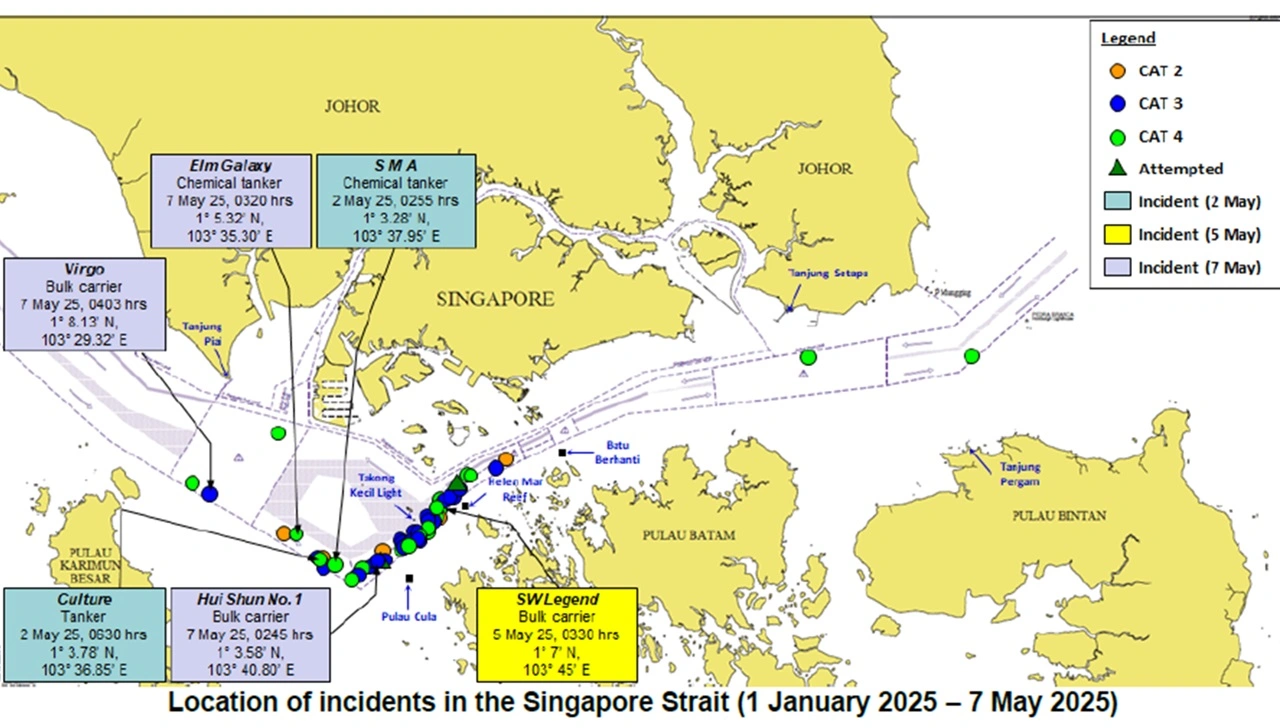
In early May alone, six incidents occurred between May 2 and 7, involving various commercial vessels transiting the strait. In comparison, only 14 cases were reported during the same time frame in 2024, underlining a steep upward trend.
ReCAAP’s latest incident alert paints a clear picture: “With these six incidents, a total of 50 incidents were reported in the Straits of Malacca and Singapore since January 2025. All incidents occurred in the Singapore Strait.”
Notably, the Malacca Strait, another strategic waterway that historically witnessed pirate activity, has seen no reported attacks so far this year — a reversal of previous trends.
Tactics and Timing – How the Robbers Operate
Almost all attacks took place under the cover of darkness, typically between 2 a.m. and 4 a.m., when visibility is low, and crew fatigue may set in. Robbers are often unarmed or lightly armed, boarding ships while they are underway and quickly escaping after stealing spare parts, engine components, or tools. In many cases, the robbers fled before anything was stolen.
A ReCAAP official noted, “In the six incidents from early May, engine spares were stolen in two. In the rest, the perpetrators left empty-handed. In all six cases, no crew members were harmed.”
These patterns suggest well-organized but low-level criminal groups with knowledge of ship vulnerabilities and navigational choke points. The Phillip’s Channel, located in the eastern part of the Singapore Strait, is particularly susceptible due to high vessel density and reduced ship speed, making it an ideal location for unauthorized boarding.
The Information Fusion Centre (IFC), a regional maritime security think tank, reported that robbers are blending into local traffic and waiting for the right moment to strike. In one February incident, multiple vessels were boarded in quick succession by the same group, underlining the possibility of coordinated gangs operating in the area.
Also read : India’s Blue Economy and Maritime Transformation toward 2030 and 2047
Vessels Targeted – From Tankers to Bulk Carriers
Recent incidents have involved a diverse range of ships. On May 7, three vessels a bulk carrier (Virgo), a chemical tanker (Elm Galaxy), and a general cargo ship (Hui Shun No.1) were boarded in separate incidents, all without major confrontation. In earlier months, ships such as the SW Legend (bulk carrier), Culture (chemical tanker), and Perias (general cargo) were also targeted.
Although there have been no fatalities or serious injuries in 2025 so far, authorities warn that the risk of escalation remains if robbers become more aggressive or if crew members resist.
Authorities Respond – Patrols, Coordination, and Warnings
The spike in sea robberies has prompted ReCAAP to issue a formal advisory to the littoral states Singapore, Malaysia, and Indonesia urging them to “increase patrols, strengthen surveillance, and enhance information sharing to track and apprehend the perpetrators.”
Singapore’s Maritime and Port Authority (MPA), Indonesia’s Bakamla (coast guard), and Malaysia’s Maritime Enforcement Agency have all reportedly stepped up patrols in the strait. Joint coordination frameworks, including aerial monitoring and cross-border pursuit agreements, are being activated to respond faster to distress calls.
The IFC also emphasized non-confrontational protocols for ship crews, recommending that mariners avoid resistance and report any intrusions promptly. Maritime safety alerts are being distributed via the ReCAAP mobile app and through Vessel Traffic Services (VTS) to notify ships transiting the danger zones.
Shipping companies, in turn, are revisiting their security protocols, including enhanced night watchkeeping, anti-boarding measures such as locked access points, and crew training on how to handle pirate boardings. ReCAAP’s “Regional Guide 2: Counter Piracy and Armed Robbery Against Ships in Asia” is being circulated as a key resource among shipowners.
Looking Ahead: Long-Term Solutions Needed
While the response has been swift, experts caution that the root causes of sea robbery such as economic hardship, weak law enforcement, and complex jurisdictional waters require long-term cooperation.
Captain S. Rajan, a maritime security analyst, commented, “Unless the tri-nation patrol regime becomes proactive and intelligence-led, we may continue to see such spikes. The robbers know the area and its weaknesses. The key is to make it harder for them to operate, not just react after incidents.”
As the global shipping industry watches closely, the Singapore Strait remains a critical test of how Southeast Asian nations can balance economic vitality with maritime security.