Russia Finds a New Route to Oil Market Via a Tiny Egyptian Port

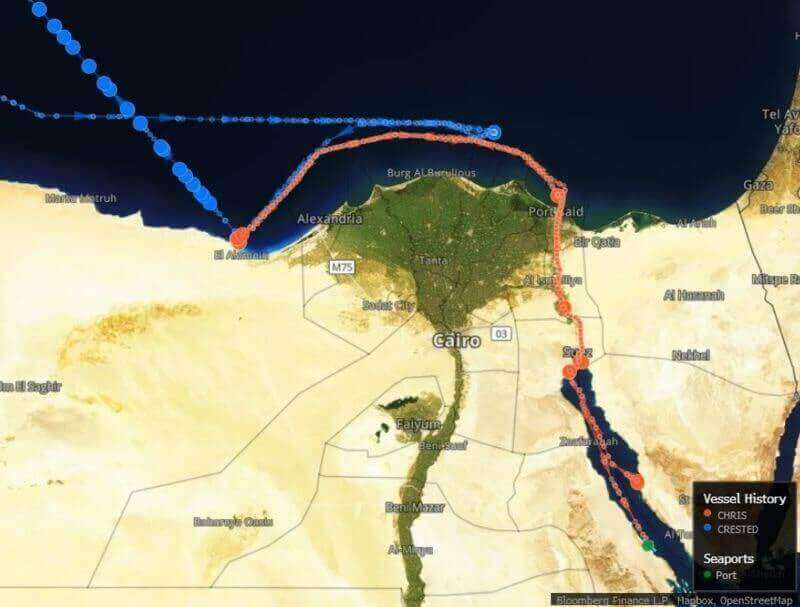
In light of impending western sanctions against Moscow, Russia appears to have discovered a new method of distributing its oil. Early on July 24, a shipment of roughly 700,000 barrels of Russian oil was delivered to Egypt’s El Hamra oil port on the country’s Mediterranean coast.

According to vessel-tracking data tracked by Bloomberg, a different vessel picked up a shipment from the port a few hours later that might have included part or all of the Russian barrels. The unusual action complicates the cargo’s final destination, which contributes to a pattern of Russian oil shipments being more veiled since European consumers started to avoid them after the country’s invasion of Ukraine.

A single buoy mooring facility is available for loading and unloading at El Hamra, which is run by Egypt’s Western Desert Operating Petroleum Co. El Hamra has six storage tanks with a capacity to contain 1.5 million barrels of petroleum.

The terminal was designed to process oil extracted from Egypt’s western desert, opening the door to the possibility of blending Russian barrels with local supplies. Numerous phone calls made to the terminal’s owner at El Hamra went unanswered.

A second tanker, the Chris, arrived a short while after the Crested, the first one, left El Hamra. The tracking information reveals that even though it had been at the terminal for a few days already, it moved off the mooring to make room for Crested to dock.

The monitoring information reveals that Chris’ cargo tanks were nearly full when it finally departed El Hamra on July 28. On Egypt’s Red Sea coast, it is currently anchored near the Ras Shukheir oil facility. There are options to mix Russian crude with Egyptian barrels at this facility as well.
Transit Route

Russia currently uses Egypt as a fuel oil transit country. It’s uncertain whether El Hamra will continue to be a unique port for Russian oil shipments or if it will expand.

Tankers transporting Russian oil have in the past exchanged cargo between ships off the coast of Ceuta, a Spanish city in North Africa, and more recently in the middle of the Atlantic. For such a challenging operation, which is often carried out in protected near-shore settings, that is an odd position.

Off Johor, close to Singapore, there seems to have been another transfer of petroleum cargo in June. The region has already developed into a hub for the transshipment of Iranian crude oil destined for China.

Later this year, the European Union will impose a ban on oil exports from Moscow as well as on the provision of insurance and other shipping services. This will increase the pressure on Russia to find and test new maritime routes for its goods.

Also Read: More than 40% of Southeast Asia’s Shipping Pollution linked to Singapore Bunker Sales

White paper finds more than 40% of Southeast Asia’s shipping pollution linked to Singapore bunker sales

The International Council on Clean Transportation (ICCT), a Washington-based independent nonprofit organization, has released a white paper on greenhouse gas (GHG) air and water pollution associated to marine fuel sales at the Port of Singapore.

According to the study, if the GHG emissions from the residual fuel sold by the largest bunkering hub, which accounted for one-fifth of all marine fuel sales reported globally in 2019, were taken into account, its total emissions impact would be four times higher than its national inventory, increasing emissions per person to six times the global average.

The study by Xiaoli Mao, Dan Rutherford, Liudmila Osipova, and Elise Georgeff discovered that while Singapore’s marine fuel sales have an impact on the environment globally, most of the pollution is localized in the seas and coastal regions that Singapore’s neighbors.

Marine residual gasoline marketed in Singapore is thought to be responsible for more than 42% of all shipping particulate matter (PM)2.5 in the seas surrounding Southeast Asia. Additionally, hotspots can be detected in the South China Sea, the Indian Ocean, and much of Oceania, including Australia’s western and southern coasts.

Due to the narrow extent of its exclusive economic zone (EEZ), the authors stated that Singapore is low in terms of absolute emissions, but is high in terms of the relative contributions of PM2.5 (35 percent) and NOx (29 percent) from ships burning residual petroleum bunkered in Singapore.

Neighboring countries, including Malaysia (37% of shipping PM2.5), Vietnam (30%), Sri Lanka (25%), Indonesia (23%), and India (22%), are also said to be heavily impacted by Singapore marine fuel sales.

The article also emphasized that Singapore’s marine fuel sales have a greater impact on scrubber wash water discharges than they do on PM2.5 and NOx emissions. “Despite scrubber wash water discharge bans in some countries, marine petroleum bunkered in Singapore is reported to be responsible for at least 40% of all scrubber discharges in the most severely impacted locations, including Vietnam, Malaysia, Sri Lanka, India, China, and Singapore itself,” it stated.

Given Singapore’s central position in the bunkering of fossil fuels, the associated air and GHG pollution from those fuels, and the significant public health effects of shipping air pollution in Asia, the ICCT findings suggest that a better understanding of pollution from marine fuels bunkered in Singapore is needed.

It further emphasized that Singapore would need to step up efforts to supply renewable fuels, explore extra steps to shift away from fossil fuel bunkering, and rethink any further investments in liquefied natural gas in order to remain a major bunkering port (LNG).

The research stated that including shipping in Singapore’s domestic GHG inventory and Nationally Determined Contribution will further show the nation’s commitment to decarbonizing its marine fuel sales.

Also Read: Singapore Bunker Contamination Reports

Adani Ports Acquires Israel Port for $1.2 Billion

July 15, 2022

The shares of Adani Ports & Special Economic Zone Ltd. increased on Friday after the Israeli government awarded the Haifa Port to a joint venture led by the Indian port operator for 4.1 billion shekel ($1.2 billion). Israel’s Finance Ministry announced late on Thursday that the firm, led by Asia’s richest man Gautam Adani, and its partner Gadot Chemical Tankers and Terminal Ltd., will purchase 100% of the equity in Haifa Port in an effort to boost competition and boost productivity.

According to a statement from the firm, Adani Ports would own a 70% ownership in the joint venture, with Gadot holding the remaining 20%. Adani Ports’ stock rose 0.9 percent in Mumbai on Friday, outpacing the benchmark S&P BSE Sensex’s gain of 0.7 percent.

Check out Gautam Adani’s tweet:

According to the petition, the port handles about half of Israel’s container trade, and the businesses have been granted the license to run it through the year 2054. Given its declared goal of becoming the largest port operator in the world by 2030, this “may be a precedent for additional M&A by Adani,” according to a note by Bloomberg Intelligence analyst Denise Wong.

“The purchase could expand Adani’s global network and solidify relationships with shippers, but the near-term profit contribution may be minimal given increasing interest payments and development costs,” according to the statement.

Global Footprint

After acquiring Holcim Ltd.’s Indian cement units for $10.5 billion in May, Adani’s ports-to-power conglomerate’s global presence has been expanding quickly. First-generation businessman Adani has been actively expanding his empire beyond the coal industry, where he made his money, into industries such as data centers, airports, digital services, media, and health care.

The statement from Karan Adani, CEO of Adani Ports, said, “In the short term, we look forward to developing strategic trade lanes between our ports in India and Haifa and help facilitate trade between the two countries.” According to him, internal accruals will be used by the corporation to pay for its investment in the port.

The most recent extension to Adani Port will face competition from a new port in Haifa, run by Shanghai International Port (Group) Co., which was inaugurated in September.

Also Read: Maersk quits ICS board over climate change stance

Maersk quits ICS board over climate change stance

July 13, 2022

Leading ocean carrier Maersk recently announced its withdrawal from the International Chamber of Shipping (ICS) board due to disagreements over climate policy, following a review of its memberships based on climate change.

Maersk, one of the world’s largest shipping companies, has been a member of the ICS board for more than a decade, but Maersk executive and board member Henriette Hallberg Thygesen has stepped down following an annual review of trade association memberships.

According to a statement on Maersk’s website, “We examine our membership status once a year to ensure that the trade groups we are members lobby in harmony with the goals of the Paris Agreement as well as other important topics.”

The Paris agreement is a binding international agreement that was established in 2015 that attempts to slow global warming by reducing greenhouse gas emissions. “Our decision to resign from the ICS Board should be viewed in this context,” it stated, without elaborating on why it disagreed with ICS’s approach.

According to Reuters, the decision was made during the ICS annual general meeting on June 22, 2022. Maersk also stated that it would prioritize its participation in the World Shipping Council (WSC), a trade organization for container shippers.

The International Chamber of Shipping (ICS), which has members from over 40 nations and represents more than 80% of the world’s commercial fleet, promotes “best practices throughout the shipping industry,” according to its website.

ICS declined to comment. Although Maersk is a part of the trade association Danish Shipping, which is a member of ICS, it is not a direct member of ICS.

In order to reach its goal of net-zero emissions by 2050, Maersk wants to establish a carbon-neutral fleet by 2030. Around 80% of worldwide trade is carried by the maritime sector, which also produces 3% of the world’s carbon emissions, thus it is high time that shipping companies take climate change seriously and act as soon as they can.

Also read: Alternative Fuels in Shipping: Ammonia, Hydrogen, and Methanol

Container ship order book outstrips tankers and bulk carriers for the first time

July 11, 2022

The severely skewed global order book is breaking all kinds of records, which will have long-term effects on the primary shipping sectors.

According to data from Clarkson Research Services, ordering in the bulker and tanker sectors, which together make up 75% of the world fleet’s dwt capacity, has been constrained in the 2020s to the point where the containership order book is now, for the first time, larger than both the tanker and bulker order books in dwt.

An all-time high of around 900 7 million teu containerships have been ordered since Q4 2020, and 94 16 million cubic meter LNG carriers have been contracted so far this year, setting a new yearly record.

On the other hand, according to Clarksons, the last year has been the least active in terms of tanker new-build contracts ever.

The tanker order book has reached a 25-year low of 35 million deadweight tonnes or a record-low 5 percent of fleet capacity.

The bulker order book is now at 69 million dwt, which is almost an 18-year low and only accounts for 7% of the fleet.

Also Read: Indian coastguard rescues 22 crew as tanker sailing from UAE takes on water

Indian coastguard rescues 22 crew as tanker sailing from UAE takes on water

On Wednesday, the Indian Coastguard saved 22 crew members from a sinking ship in the Arabian Sea off the coast of Gujarat. The crew of the MT Global King put out a distress signal, and the maritime agency responded by dispatching at least two helicopters.

The 118-meter tanker departed Khor Fakkan in the UAE and headed toward Karwar in the state of Karnataka. The crew sent out a Mayday signal when it started taking on the water close to the Porbandar shore. It was transporting bitumen, an oil industry byproduct, in the amount of 6,000 tonnes. Twenty Indians made up the crew, and one came from Pakistan and Sri Lanka each.

Video footage showed the ship listing.

The Indian Coastguard tweeted, “In a quick rescue effort, all 22 crew members of distressed vessel MT Global King rescued by Indian Coastguard… launched from Porbandar to 93 nautical miles into the sea.”

“Everyone on board is safe and healthy.”

A coast guard helicopter’s video captured the vessel listing and a life raft close to the ocean. According to tanker monitoring services, the ship frequently transports cargo between the UAE, Oman, and India while flying the flag of Panama.

Also Read: Cruise Ship Strikes an Iceberg in Alaska

Cruise Ship Strikes an Iceberg in Alaska

June 30, 2022

A video posted online by passengers on a Norwegian cruise ship that left on a nine-night journey shows that it collided with an iceberg. When the massive cruise liner strikes the iceberg, a passenger exclaims, “Titanic 2.0,” conjuring images of the RMS Titanic, which sank in 1912 after hitting an iceberg close to Newfoundland, Canada. According to CNN, the Norwegian cruise liner struck the “growler” iceberg on Saturday as it was making its way to Hubbard Glacier in Alaska.

The ship’s side nudges a massive chunk of transparent grey ice over the water in the footage that was posted on Twitter before continuing on. The terrified passengers can be heard panicking as the ship collides with the iceberg in the middle of the ocean, near Alaska.

It has been determined that the iceberg is a “growler,” which is defined as being less than two metres broad and having less than one metre above the sea. CNN also reported that the remaining portion of the voyage had been cancelled by Norwegian Cruise Line and that the ship had returned to Juneau port for a safety inspection.

The Coast Guard Sector Juneau Prevention Team and hired divers examined the ship’s right front side and found no damage, so it may return to its home port of Seattle for additional repairs. The Norwegian Cruise Line (NCL) said that the United States Coast Guard and other regional maritime authorities had given the ship permission to return to Seattle at a slower pace. The statement said, “All passengers presently aboard will depart in Seattle as previously scheduled.”

The incident, which also resulted in “cosmetic” damage to the ship and damage to various pieces of the port infrastructure, did not appear to hurt any passengers.

Also Read: Toxic gas leak at Jordan’s Aqaba port kills 13, injures hundreds

Toxic gas leak at Jordan’s Aqaba port kills 13, injures hundreds

June 28, 2022

On Monday, a crane putting chlorine tanks onto a ship at the port of Aqaba, Jordan, dropped one of them, setting off a massive explosion of poisonous yellow smoke that wounded more than 250 people and claimed the lives of 13 individuals. Authorities claim that a crane malfunction caused a chemical storage container to fall while being carried, according to the AFP.

The event was captured on surveillance video, which showed the container being lifted into the air before suddenly falling into a ship and exploding. On the ground, a sizable cloud of bright yellow gas is visible expanding. Dockworkers may also be seen scurrying to get away from the poisonous fumes.

The government’s crisis cell announced in a statement that “a chlorine gas leak occurred in Jordan’s port of Aqaba at precisely 15:15 this afternoon as a result of the fall and explosion of a tank storing this material,” according to AFP.

Have a look at this video uploaded by Suzanne on Aqaba incident

According to the most recent report on the death toll, 123 individuals were still hospitalized on Tuesday. Some were in critical condition. After visiting the port late on Monday, Prime Minister Bisher al-Khasawneh said on state television that “the situation in Aqaba is now under control.”

The city of Aqaba, located 16 kilometers north of the port, was warned by the authorities to stay indoors and cover windows and doors after the occurrence. The southern shore of Aqaba was also evacuated out of prudence.

Additionally, to handle the leak and clean-up operation, the Civil Defense Department dispatched specialized personnel to the port. The interior minister, Mazen Faraya, was given the task of leading an inquiry when Jordan’s prime minister traveled to Aqaba.

Separately, the container’s “iron rope” “broke” when it was being carried onto a vessel,” the deputy director of the port of Aqaba told AlMamlaka TV. He stated that the container was being shipped to Djibouti and contained between 25 and 30 tonnes of chlorine.

Chemicals containing chlorine are utilized in both industry and domestic cleaning products. At standard pressure and temperature, it is a yellow-green gas. Chlorine combines with water to form acids that harm body cells when it is breathed, ingested, or comes into contact with the skin. Pulmonary oedema, a potentially fatal illness, is brought on by breathing in large amounts of the gas.

Also read: Livestock Carrier Capsizes and Sinks, Killing 15,000 Sheep

Smart container fleet to expand 8-fold over 5 years – Says Drewry

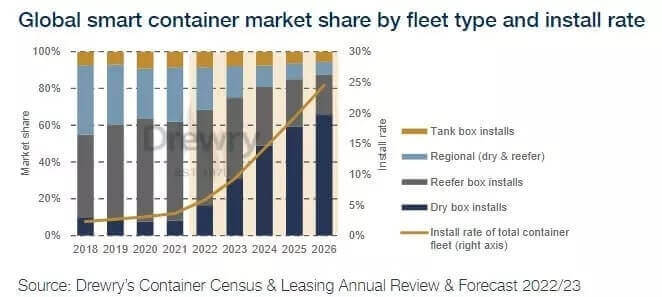
According to the latest Container Census & Leasing Annual Review & Forecast 2022/23 report from Drewry, which will be released later this month, the global telematics-enabled container equipment fleet is expected to increase eightfold over the next five years and account for 25% of the world’s box inventories by 2026. This growth will be fueled by wider adoption across the dry container fleet.

“After the Covid-19 outbreak broke out and the ensuing supply chain disruption emphasized the need for improved cargo visibility to handle longer and more unpredictable transit durations, smart containers have gained in popularity. Over the following five years, it is anticipated that the adoption rate of smart containers would quicken.”

When a telematics device is installed on a container, the container becomes “smart,” allowing operators to speed up container turnaround and thereby boost equipment availability. In order to better manage their supply chains, it also enables beneficial cargo owners (BCOs) to comprehend the position and condition of their cargo.

According to Drewry, the demand for enhanced visibility of cargo flows and container fleet management is being driven by ongoing supply chain disruption and port congestion, both of which show no signs of subsiding. “Carriers have enough money to spend on new projects and perceive chances to increase the effectiveness of their operations by deploying smart containers.”

Following growth of more than 30% throughout the year, Drewry predicts that by the end of 2021, around 3.6 percent of the world’s fleet of container equipment will be fitted with smart technology gadgets.

“The take-up, however, varies greatly depending on the kind of equipment, with penetration being very substantial in the reefer and intermodal container sectors, but much lower in the dry box sector. A third of the fleet of marine reefer containers are now smart-enabled, compared to more than 40% of intermodal containers.”

According to Drewry, the global fleet of smart containers will grow to over 8.7 million units in the five years leading up to 2026, accounting for up to 25% of all box stocks globally. “Uptake is likely to accelerate” as a result of technology advancements that reduce device costs and increase their value to both transport operators and BCOs.

According to Drewry estimates, the dry container fleet, whose penetration is now as low as 0.3 percent, will now be the main driver of the smart fleet acceleration. The recent declaration by Hapag-Lloyd that it plans to outfit its entire dry box fleet with smart devices may compel other top carriers to follow suit.

Return on investment for shipping lines will come from the opportunity to optimize their box fleet and cargo business. Previous attempts to build a dry smart fleet were unsuccessful because they relied on BCO demand, which was discouraged by extra costs and a lack of carrier IoT service integration.

According to Drewry’s analysis, shipping lines will concentrate on installing a critical mass of smart devices to gain operational advantages throughout their container fleets and cargo operations as they get ready for the next advancement in service offerings for supply chain visibility.

Also Read: Shipping Ministry Announces 6 Service Opportunities For Agniveers

Shipping Ministry Announces 6 Service Opportunities For Agniveers

June 18, 2022

New Delhi: On Saturday, the Ministry of Ports, Shipping, and Waterways (MoPSW) announced six service options for Agniveers to seamlessly transition into various Merchant Navy professions after serving in the Indian Navy.

An official statement claims that the program will give Agniveers the training, experience, and credentials they need to join the lucrative merchant navy anywhere in the world. The statement comes in the midst of intense opposition to the recently disclosed “Agnipath” initiative, which calls for the short-term contractual enlistment of troops into the armed services. The soldiers hired under this plan will be referred to as Agniveers.

The statement claims that these programs for Agniveers include transitions from Indian Navy ratings to certified ratings in the Merchant Navy, from Indian Navy electrical ratings to certified electro-technical ratings in the Merchant Navy, and from Indian Navy ratings to certified class IV-NCV CoC holders in the Merchant Navy.

Additionally, it will involve the change from Indian Navy electrical ratings to Merchant Navy qualified electro technical officers and the shift from Indian Navy kitchen to Merchant Navy certified cook. According to the statement, some of the programs are intended for Agniveers who have a diploma in mechanical or electrical engineering or an ITI trade certificate in the electronic or electrical stream and either joined the Indian Navy with these credentials or acquired them while serving there.

For those Agniveers who desire to participate in any of the aforementioned initiatives through the Indian Navy, it was said that the MoPSW will issue the Indian National Database of Seafarers (INDOS) and Continuous Discharge Certificate (CDC).

The government on Thursday night raised the maximum age for hiring under the “Agnipath” plan from 21 to 23 years old, with effect for the year 2022, in an effort to appease the demonstrators. In announcing the program on Tuesday, the government had stated that young people between the ages of 17 and a half and 21 would be hired for a four-year term, with 25% of them being hired later on for regular service.

The plan’s reduction of the military workforce’s average age and reduction of the soaring wage and pension costs are two of its main goals. The military’s recruitment process had been suspended for more than two years due to the coronavirus epidemic when the new program was announced.

Also read: Women occupy only 5% of maritime leadership roles

The Ever Given incident may cost $2Bn in claims 

June 16, 2022

According to a top French reinsurer, the Ever Given containership’s six-day blockade of a crucial maritime commerce corridor last year might result in more than $2 billion in claims. The Ever Given, which is 400 metres long and weighs 200,000 tonnes, went aground in March while being piloted through the Suez Canal on its way to Rotterdam, Netherlands.

One of the most important maritime trade routes connecting Asia, the Middle East, and Europe is the canal, which is 120 miles long but only 205 metres wide and 24 metres deep. The Ever Given became stranded at an angle, obstructing the passage of other ships.

“A major, direct consequence of the Ever Given disaster is supply-chain interruption,” says Gregory Delaisse, Scor’s global head of maritime & transport for speciality insurance. Shipping, according to the corporation, is a complicated sector that employs millions of people worldwide and serves as the backbone of international trade and commerce.

90% of all consumer goods, whether as raw materials, components, or finished goods, travel by sea at some point during their manufacture and delivery. Some items go through numerous phases in the production process and so travel around the world multiple times before reaching the consumer.

“The grounding of the Ever Given has revealed the underlying truth of our economic system,” argues Scor’s chief underwriting officer for marine and energy reinsurance, Sylvain Gauden. According to Scor, 52 ships sail through the Suez Canal every day.

At 20 knots, one of these ships can round the world in a few weeks. A ship charter may cost up to $100,000 per day. Someone is depending on each of the 15,000 to 20,000 containers they transport, and time is of the importance. Some of the items are perishable, while others aren’t.

Mr Delaisse says, “As re/insurers, we need to evaluate our possible exposures. Container ships are becoming bigger, yet there is a container scarcity at the same time. As a result, some shippers are transporting cargo on insufficient bulk carriers.”

According to Scor, up to 400 ships were halted in total. With the canal closed, several shipping corporations were investigating – and perhaps beginning on – an other route via the Cape of Good Hope, despite the long and costly consequences.

Scor said that the Ever Given event is compounded by the fact that all of the parties involved – the ship owner, the charterer, the cargo owners, and even the Suez Canal – have insurance coverage from all over the world. All of them are attempting to recoup at least part of their losses.

Physical damage (to the Ever Given), loss of income (on the part of the Suez Canal Authority), expense of salvage operations and business interruption (for owners and charterers of the stopped boats), loss of perishables and cargo delays, as well as harm to the canal itself, according to Scor.

Mr Gauden explains, “Understanding the effects of such an occurrence necessitates having a comprehensive picture.” “Who are the stakeholders? Which insurance coverage will be able to help? What is the extent of their exposure? How much will this set you back? All types of maritime insurance are affected, and the stakes are high and sometimes conflicting.”

Scor predicted that settling the Ever Given’s claims would take several years, and that the process would contain a lot of argument over who is responsible, noting that the question of obligations and applicable rules in today’s global marine environment is complicated.

UN Launches Crowdfunding Campaign In Millions To Prevent Major Disaster From Decaying Oil Tanker

June 14, 2022

The United Nations (UN) began a social media campaign on Monday to bring the globe closer to stopping an oil spill from an aging FSO moored off Yemen from wreaking calamity for the area and beyond. The aim is to generate enough money to begin the $80 million emergency transfer of oil from the FSO Safer to a temporary vessel.

The FSO Safer is anchored off the coast of Yemen and holds over a million barrels of oil. The tanker is beyond repair, and there is a risk that it could explode or break apart shortly. It is one of the world’s largest tankers, measuring 376 meters in length and carrying almost four times the amount of crude oil spilled in the 1989 Exxon Valdez catastrophe off the coast of Alaska.

The Safer has been moored just a few miles off the coast of Yemen for more than 30 years, but dumping and maintenance were halted in 2015 due to the fighting between the pro-government coalition and Houthi rebels.

The UN is prepared to carry out the emergency rescue mission, but the transfer operation is being postponed because of a lack of finance. Following Saudi Arabia’s announcement of a $10 million donation this week, around three-quarters of the needed funds have been received. The US is also working on a $10 million gift.

David Gressly, the United Nations (UN) Humanitarian Coordinator in Yemen, has started a crowdfunding drive to raise $5 million in individual donations by the end of this month so that work may begin in July. The transfer is part of a $144 million two-track proposal that also includes the installation of a replacement vessel for the FSO Safer.

Also read: UK and EU agree to ban insurance on ships carrying Russian oil

Livestock Carrier Capsizes and Sinks, Killing 15,000 Sheep

June 12, 2022

A ship transporting about 16,000 sheep collapsed and sunk on Sunday at its dock in a Sudanese port. All of the crew members made it out alive, but nearly all of the cargo was lost. In the early hours of Sunday morning, the vessel Al Badri 1 (misreported as the Badr 1) began sinking at the pier in Suakin, Sudan.

Officials informed The Guardian that the ship sank slowly, giving the crew adequate time to leave. Only 700 sheep managed to flee and survive. Because of the possibility of a fuel oil spill and the effluent from the decay of thousands of sheep, the loss of the Al Badri 1 might have an impact on port operations as well as the environment.

The ship is currently underwater near its berth, preventing the pier from being used until the wreck is cleaned.

The Al Badri 1 (also known as Henry Stahl, Ester 1, Ytong 1, Malak 1) was a stern-ramp ro/ro freighter constructed in 1973 that was later converted into a livestock carrier.

She had a recent history of port state control violations, as well as a 10-year period between 2008 and 2018 with no PSC inspections. Four more decks were welded above the ship’s main deck level to offer more space for cattle, according to images taken before and after the Al Badri 1’s renovation.

Livestock carriers are usually older than commerce ships across the world, with an average fleet age of more than 40 years. Almost all of them are conversions from ro/ro ships. According to a 2021 research by Animal Welfare Foundation, Tierschutzbund Zürich, and Robin des Bois, the ships chosen for conversion have often arrived at the standard age for demolition (about 30) when they begin their new life.

In November 2019, a similar occurrence occurred onboard the cattle ship Queen Hind. Under rare circumstances, the vessel crashed off the coast of Romania, drowning nearly all of the 15,000 sheep on board.

Also Read: The ‘Spirit of Norfolk’ Passenger Cruise Catches Fire with 89 School Children

Thousands of South Korean Truckers Broaden Strike Action

June 10, 2022

Thousands of South Korean unionized cargo truckers are on strike for the fourth day, protesting rising gasoline prices and demands for basic salary guarantees. The strike has caused manufacturing to be disrupted for a wide range of businesses, stymied port operations, and added new hurdles to an already strained global supply chain.

On Friday, truckers expanded their protest to the country’s major ports, threatening to halt shipments of semiconductor raw materials and petrochemical goods. South Korea is a major provider of semiconductors, cellphones, automobiles, batteries, and technological goods across the world. Because of the COVID-19 epidemic and Russia’s invasion of Ukraine, global supply networks are stretched.

What are the demands of South Korean Truckers?

According to the country’s transport ministry, almost 7,200 members of the Cargo Truckers Solidarity union are on strike, accounting for around 30% of the organization’s membership. Truckers have protested at POSCO, a Korean steelmaker, as well as Hyundai and Kia, two Korean automakers.

Due to the protest, production at Hyundai’s largest facility in Ulsan’s industrial heartland was half on Thursday. According to Reuters, a Hyundai representative said, “There are some interruptions to our products owing to the truckers strike, and we hope production will be resumed as soon as feasible.”

The truckers, who are classified as self-employed in South Korea, are demanding salary raises as well as a pledge to extend an emergency measure ensuring freight rates, or a promise to guarantee fixed pricing for their deliveries. The measure, which was put in place during the coronavirus outbreak, is set to expire in December.

First challenge for the newly elected president

Meanwhile, new conservative President Yoon Suk-yeol, who took office last month after inheriting major economic issues, has stated that labor-management disagreements should be settled without government interference.

“I believe labor and management will be able to establish the capacity to freely settle their disputes on their own only if the government conforms to the law and principles and remains impartial,” he said on Friday, according to the South Korean news agency Yonhap.

Yoon dismissed claims that his “hostile” attitude toward workers was escalating tensions.

Also read: Russia-Ukraine crisis: Crude oil prices soar past $100 a barrel – Cause for worry for India

The ‘Spirit of Norfolk’ Passenger Cruise Catches Fire with 89 School Children

June 7, 2022

While running a field trip for elementary school pupils, a well-known excursion ship that conducts excursions in Norfolk port and along the Elizabeth River caught fire today. Local fire agencies, with the help of the US Navy and the US Coast Guard, battled the blaze and reported that all 108 persons aboard were safe, despite the fact that the fire is still burning.

The 187-foot Spirit of Norfolk caught fire at noon today, June 7, as it was docked near Naval Station Norfolk. There were 89 students on board, as well as professors and chaperones. After determining it was a larger excursion ship, fire and emergency services reacted to reports of a boat fire and swiftly phoned in the fire to local emergency dispatchers.

Passengers on board the ship said they first smelled the fire and then saw flames and thick smoke pouring from the engine room. The crew gathered all of the children and passengers on board and hastily strapped them into life jackets before escorting them to the upper deck.

As the fire became larger and fireboats were positioned nearby, onlookers gathered around the coastline and pier. The decision was taken to relocate the passengers to another excursion boat as they continued to combat the fire.

The decision was taken to relocate the passengers to another excursion boat as they continued to combat the fire. Before ferrying the people to land, they hauled the smaller Victory Rover alongside and transferred the passengers to the second craft.

Two crew members stayed on the Spirit of Norfolk to aid the firemen, and the ship was hauled to the military base’s Pier 4 shortly after. During an afternoon news conference, Naval Station Norfolk Fire Chief Tony Sickell described the fire as “extremely deep-seated, highly complex, and very tough to suppress. Right now, we’re doing all we can to cool the hull and deliver water to the source of the fire in the engine room, where we suspect it began.”

Firefighters used foam, but there was little risk of damage to individuals on the ground and just a minor risk of environmental contamination for the ship. The fire was reported to be still blazing aboard the vessel as of early evening.

The Spirit of Norfolk, which was built in 1992, is a regular sight along the local shoreline. The ship conducts excursions in Norfolk harbor, such as today’s school field trip and dinner cruises. When performing its excursions, it can carry up to roughly 500 guests and is owned by the Hornblower Group of California.

According to company executives, the safety of their passengers is always their first priority, and the ship is inspected by the US Coast Guard on a regular basis, and the crew conducts numerous safety exercises. The inquiry into the cause of the fire will be led by the United States Coast Guard.