India Maritime Week 2025: A Historic Milestone for India’s Maritime Growth
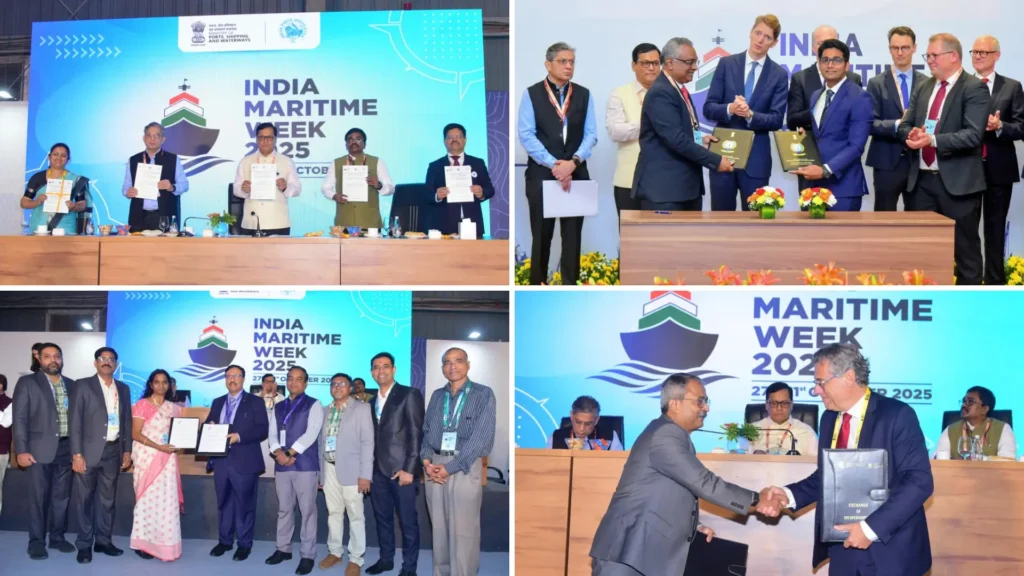
India Maritime Week 2025 has marked one of the most remarkable chapters in the country’s maritime journey. With an investment commitment of more than ₹12 Lakh Crore and the signing of over 600 Memoranda of Understanding (MoUs), the event stands as a huge boost to India Maritime Week 2025, setting strong foundations for port development, green shipping innovations, and the strengthening of India’s blue economy.
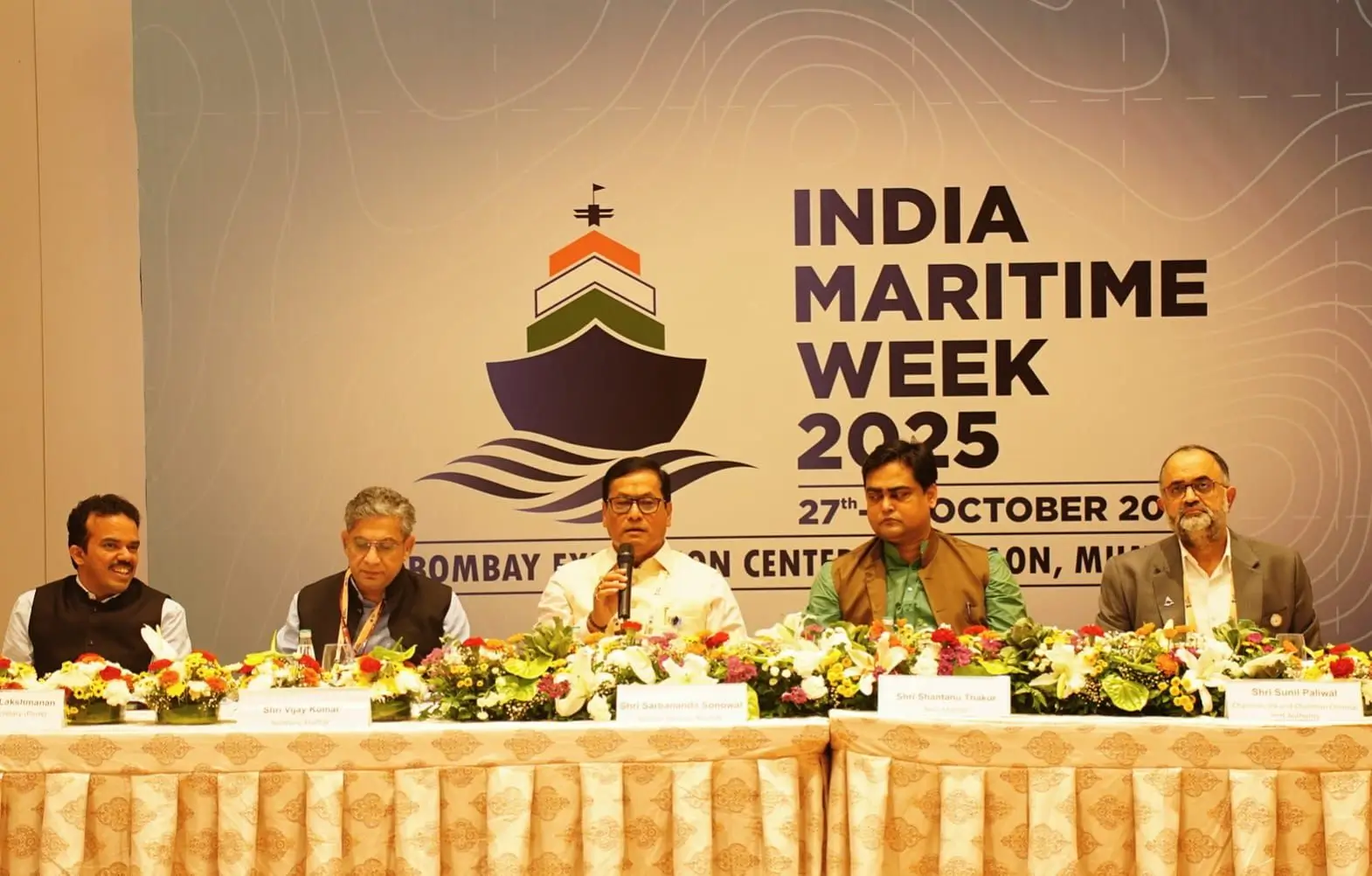
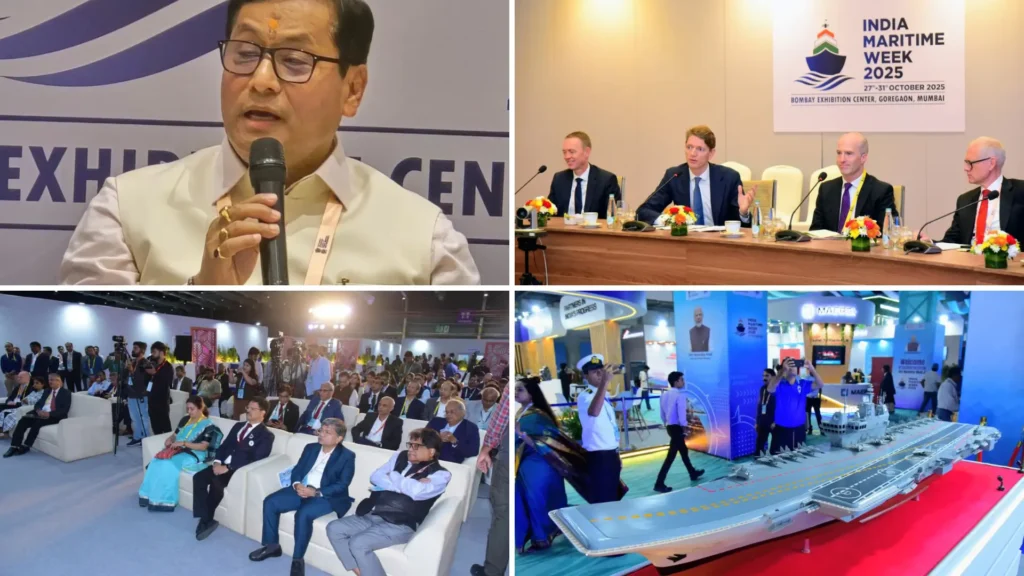
Addressing the media, the Union Minister for Ports, Shipping and Waterways, Sarbananda Sonowal, described the success of India Maritime Week 2025 as a reflection of growing maritime investment confidence in India. He also highlighted the 41% rise in investments compared to previous editions, showcasing India’s increasing global maritime relevance.
The Minister credited Prime Minister Narendra Modi’s strategic and visionary leadership for driving growth in port development, coastal infrastructure, and the sustainable transformation of the maritime sector.
Prime Minister Modi’s Landmark Maritime Initiatives
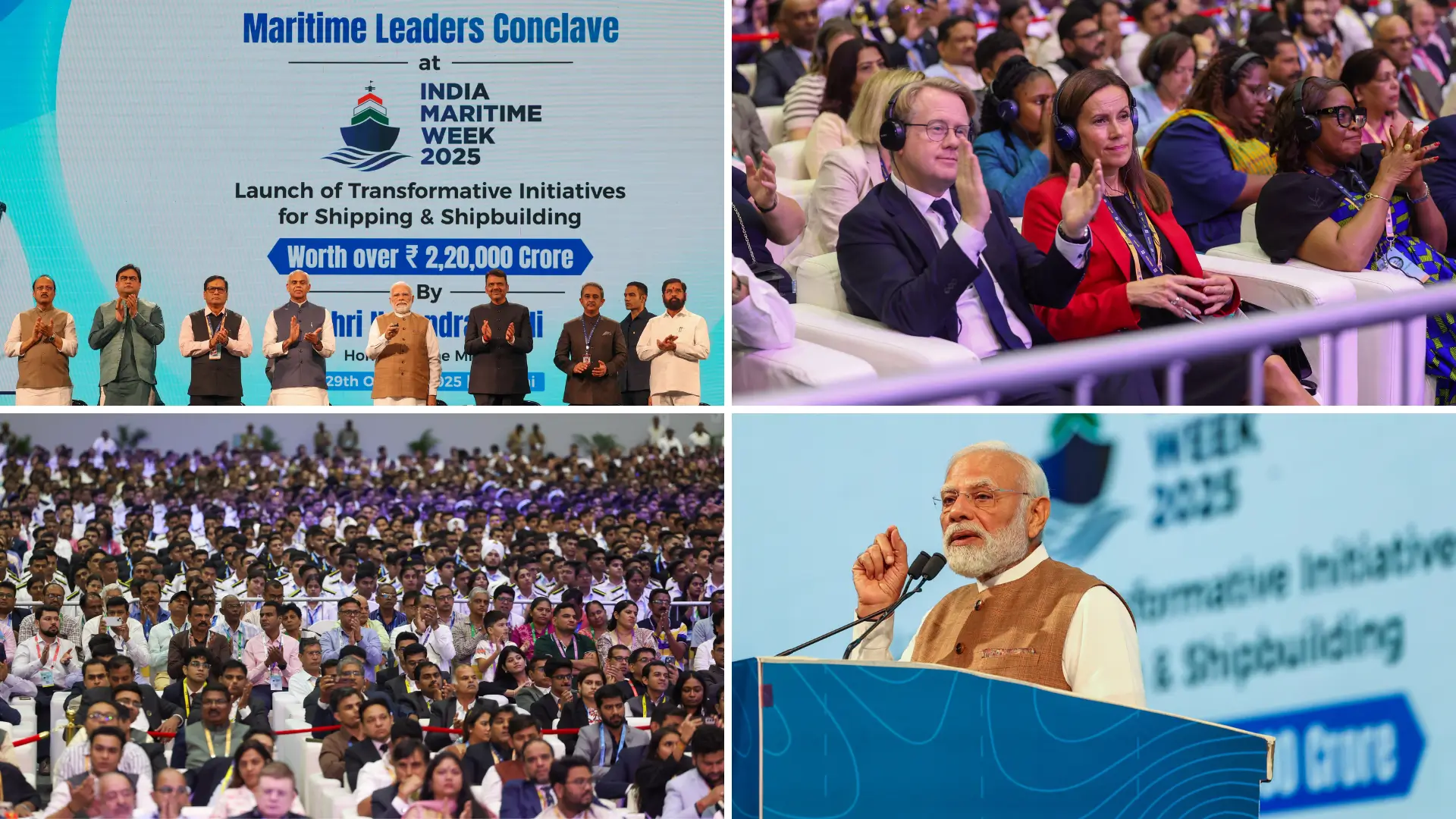
On the third day of India Maritime Week 2025 (29 October 2025), Prime Minister Narendra Modi unveiled several transformative initiatives under the Maritime Amrit Kaal Vision (MAKV) 2047. These initiatives aim to make India a global maritime leader, expand coastal trade capacity, boost local manufacturing, and build sustainable green shipping networks.
Fleet Expansion and Shipbuilding Growth
The Shipping Corporation of India (SCI) announced a major expansion plan to increase its fleet to 216 vessels by 2047.
This initiative involves ₹1 Lakh Crore investment and will add 10 million Gross Tonnage (GT).
The move strengthens India’s competitiveness in global trade and enhances self-reliance.
Boost to Indigenous Shipbuilding
Oil and Gas Public Sector Units (PSUs) placed 59 shipbuilding orders worth ₹47,800 Crore.
This supports Make in India, encourages local shipyards, and creates employment in coastal states.
The Green Tug Programme was launched to introduce 100 environment-friendly tugs by 2040.
This step advances green shipping, reduces carbon emissions, and modernizes port operations.
Improving Coastal Infrastructure
The Dredging Corporation of India (DCI) will modernize its fleet with 11 new dredgers, supporting smoother waterways and trade route efficiency.
Together, these announcements reflect India’s commitment to building a sustainable and advanced blue economy ecosystem.
Global Maritime CEO Forum: A Platform for Collaboration
The Global Maritime CEO Forum during India Maritime Week 2025 brought together:
Maritime industry leaders
Global corporations
Policymakers
Innovation experts
Prime Minister Modi emphasized cooperation, innovation, and sustainability. Global CEOs praised India’s forward-looking maritime policies and expressed strong intent to increase maritime investment in India, especially in green shipping, smart port automation, and digital trade logistics.
₹12 Lakh Crore Investment Through 600+ MoUs
The signing of over 600 MoUs worth more than ₹12 Lakh Crore marks a powerful step toward building a future-ready blue economy. The investments are strategically allocated across key areas:
Sector
Investment % Share
Port Development & Modernisation
30%
Sustainability & Green Shipping
20%
Shipping & Shipbuilding
20%
Port-led Industrialisation
20%
Trade and Knowledge Partnerships
10%
Notable High-Value MoUs
VoCPA & Jindal India Power Ltd. – ₹47,000 Crore Green Ammonia Plant in Tuticorin.
Paradip Port Authority (PPA) & ACME Clean Tech – ₹45,000 Crore Green Hydrogen Project.
International Participation Strengthens Global Maritime Ties
India Maritime Week 2025 witnessed participation from:
85+ Countries
400+ Exhibitors
More than 1,00,000 Delegates
11 Foreign Ministers and multiple global policymakers
Nations like Norway, Denmark, Singapore, the Netherlands, and UAE contributed significantly through technology showcases and policy dialogues, enhancing global cooperation in blue economy development.
Key industry giants such as Maersk, DP World, CMA CGM, MSC, Wartsila, and Royal IHC participated, presenting futuristic solutions in green shipping, AI-driven automation, and digital port transformation.
Conferences, Dialogues, and Innovation Showcases
More than 19 thematic conferences and 50+ sub-sessions highlighted:
Green Maritime & Decarbonization
Digital Transformation of Ports
Shipbuilding for Global Markets
Maritime Corridors and Global Trade Growth
Women Leadership in Maritime (SheEO Conference)
A key highlight was the launch of Digi Bandar, a national digital port framework to make Indian ports:
AI-driven
Data-integrated
Predictive and automated
This supports modern logistics, reduces delays, and enhances global trade competitiveness.
Strengthening Maritime Talent and Coastal Employment
A dedicated session on Maritime Human Capital focused on:
Skill development programs
Training in smart port operations
Increasing women’s participation in maritime professions
This ensures a future-ready workforce to support India’s long-term maritime investment and blue economy growth.
A Major Step Toward Viksit Bharat 2047
India Maritime Week 2025 stands as a milestone shaping India’s maritime future. The strong push toward green shipping, modern port development, and sustainable blue economy practices confirms India’s rise as a global maritime power.
With massive investments, international alliances, digital transformation, and focus on indigenous innovation, India is steadily moving toward the vision of Viksit Bharat 2047 — a future where India leads the world in maritime excellence.
Prime Minister Modi addressed the Maritime Leaders Conclave and chaired the Global Maritime CEO Forum during India Maritime Week 2025 in Mumbai, Maharashtra. Welcoming global delegates, investors, policymakers, port authorities, and maritime innovators, he stated that the event has grown from a domestic industry initiative in 2016 into a global summit that now represents shared maritime interests and aspirations across continents.
Participation from more than 85 countries, including small island developing states, major shipping companies, and global port operators, marked the Conclave as one of the world’s largest platforms for maritime cooperation and knowledge exchange. India Maritime Week 2025 aims to shape the nation’s maritime vision for the next two decades, with sustainability, competitiveness, and collaboration at its core.
The maritime sector is driving India's growth. Over the last decade, it has transformed significantly, boosting trade and port infrastructure. Addressing the Maritime Leaders Conclave in Mumbai. https://t.co/09OG8ZTWRl
A Vote of Global Confidence in India’s Maritime Growth
Prime Minister Modi emphasized that the signing of Memorandums of Understanding worth several lakh crores during the summit reflects growing international confidence in India’s maritime capabilities. He noted the presence of leaders from global shipping companies, maritime startups, blue economy research institutions, and technology firms as a sign of shared commitment to shaping the future of the world’s oceans. “In the 21st century, India’s maritime sector is advancing with great speed and energy,” the Prime Minister remarked.
India’s Major Maritime Milestones in 2024–25
Prime Minister Narendra Modi highlighted several landmark achievements in India’s maritime sector during 2024–25, marking a year of significant progress in port operations, infrastructure expansion, and green energy adoption. Vizhinjam Port, India’s first deep-water international transshipment hub, became operational this year. The world’s largest container vessel recently berthed here, underscoring India’s growing relevance in global shipping routes.
India’s major ports recorded their highest-ever cargo handling volumes, demonstrating increased efficiency and expanding global trade linkages. At Kandla (Deendayal) Port, India’s first indigenous megawatt-scale green hydrogen facility has been commissioned, positioning the country for future clean fuel production and maritime decarbonisation.
Phase 2 of the Bharat Mumbai Container Terminal at JNPT has been inaugurated, doubling the terminal’s handling capacity. This expansion was supported by the largest foreign direct investment in India’s port infrastructure, enabled through a strategic partnership with Singapore. Together, these developments signal India’s emergence as a central logistics and trade anchor within the Global Maritime Hub network.
वर्ष 2025 देश के Maritime Sector के लिए अत्यंत महत्वपूर्ण साबित हुआ है। इस वर्ष हमारी उपलब्धियों के ऐसे कई उल्लेखनीय उदाहरण देखने को मिले हैं… pic.twitter.com/O0cit3SAP0
Prime Minister Modi highlighted that India has replaced outdated colonial-era maritime laws with modern frameworks that align with global standards and support 21st-century maritime needs.
Merchant Shipping Act Modernisation
Aligns Indian maritime safety provisions with international conventions
Enhances ease of doing business for shipping and logistics companies
Reduces government intervention and compliance burden
Strengthens global confidence in Indian shipping practices and seafarers
Coastal Shipping Act
Simplifies coastal trade procedures
Enhances supply chain security
Promotes balanced coastal economic development
One Nation, One Port Process
Standardizes port documentation across the country
Reduces delays and paperwork
Improves logistics efficiency across domestic and global trade corridors
Port Efficiency Gains Over the Past Decade
The past ten years have seen transformational improvements across India’s ports and inland waterways.
Indicator
Earlier
Now
Impact
Operational waterways
3
32
700% increase in inland water cargo movement
Major port capacity
Nearly doubled
Sustained surplus
Stronger trade handling capability
Container dwell time
7+ days
< 3 days
Faster than several developed nations
Vessel turnaround time
96 hours
48 hours
Increased port competitiveness
Number of Indian seafarers
1.25 lakh
3 lakh+
India now ranks top 3 globally
The Prime Minister stated that Indian ports are now among the most efficient in the developing world, and in several cases, outperform ports in advanced economies.
When the global seas are rough, the world looks for a steady lighthouse.
Looking ahead, the Prime Minister emphasized that the coming decades will define India’s ocean-linked identity.
Key national priorities include:
Blue Economy expansion
Green logistics corridors
Coastal industrial and export clusters
Low-emission and climate-resilient port ecosystems
The Blue Economy will play a critical role in:
Food and energy security
Coastal livelihood support
Resilient global trade connectivity
Shipbuilding as a Strategic Priority
The Prime Minister underlined that shipbuilding is central to India’s maritime strategy.
Historical Legacy
India has a long tradition of shipbuilding, reflected in ancient maritime craftsmanship and early vessel designs depicted in the Ajanta cave murals. Indian-built ships once played a significant role in global maritime trade.
Present Momentum
India is accelerating:
Greenfield and brownfield shipyard expansion
Skill development for marine engineering and ship repair
Private sector and foreign investment participation
₹70,000 Crore National Investment Push
The Government will invest ₹70,000 crore to:
Expand shipbuilding capacity
Support indigenous manufacturing of commercial and naval ships
Enable long-term, lower-cost financing for shipyards
New Mega Port at Vadhavan: Boosting Global Supply Chain Strength
A ₹76,000 crore deep-water mega port is being developed at Vadhavan, Maharashtra, designed to handle the world’s largest vessels and expand India’s share in global container shipping.
The project is expected to:
Significantly increase cargo capacity
Support coastal industrial and logistics clusters
Strengthen global supply chain resilience
The Prime Minister invited investors, shipping companies, logistics firms, and port operators to participate under “Make in India, Make for the World.”
India as a Stable Maritime Partner
In a world facing geopolitical tensions and shifting supply chains, India positions itself as:
A stable democratic maritime power
A reliable logistics and trade partner
A bridge between developed and developing maritime economies
A responsible advocate for sustainable oceans
He also emphasized supporting Small Island Developing States and Least Developed Countries, ensuring that the Blue Economy remains inclusive.
Source : Ministry of Ports, Shipping & Waterways (PIB)
India Maritime Week (IMW) 2025 marked a significant moment for India’s maritime transformation, spotlighting sustainability, technological innovation, port modernization, and domestic defence shipbuilding. Senior policymakers, international partners, maritime businesses, shipowners, technologists, and port leaders participated in discussions that underlined India’s ambition to emerge as a leading global maritime hub in the coming decades.
Day Two of IMW 2025 focused on thematic sessions on Green Maritime, Inland Waterways, Maritime Safety and Security, Cruise and Passenger Economy, and Strengthening Global Supply Chains — signalling a comprehensive approach to building a future-ready maritime sector.
Green Maritime Day – India’s Net Zero Pathway
Speaking at the Green Maritime Day session, Union Minister for Ports, Shipping and Waterways Sarbananda Sonowal emphasized India’s commitment to building a cleaner, smarter, and more resilient maritime ecosystem.
He noted that over 95% of India’s trade by volume moves through the sea, making the maritime sector central to economic development. Under India’s Net Zero by 2070 commitment, the government aims to reduce carbon emissions per ton of cargo by 30% by 2030 and 70% by 2047.
“Our goal is not only to expand maritime capacity but also to make it greener, smarter, and more resilient,” Sonowal said.“ India is positioned along key global trade routes and is ready to become a hub for green shipping corridors connecting domestic and international markets through clean energy trade.”
Green Hydrogen and Port Decarbonisation
India is actively developing green hydrogen ecosystems, with VOC Port, Paradip Port, and Deendayal Port designated as green hydrogen hubs. These hubs will enable production, bunkering, and export of green fuels, supporting new economic opportunities and jobs.
More than 12 million metric tonnes of green hydrogen-based e-fuel capacity has already been announced nationwide. To cut emissions from vessels at berth, India introduced its first national shore-power standard, enabling ships to draw renewable electricity while docked. Ports such as JNPA are transitioning to battery-electric logistics systems, including electric trucks and yard equipment.
Global Collaboration – Partnerships with Singapore, Rotterdam, Norway and Sweden
India launched Green and Digital Shipping Corridors (GDSCs) with:
Singapore
Port of Rotterdam (Netherlands)
These corridors are expected to:
Enable cleaner shipping fuel usage
Digitize cargo and vessel movement systems
Facilitate green trade investments
Strengthen India’s position in global supply chains
Country sessions with Norway and Sweden focused on AI-driven port automation, electric vessel technology, LNG and methanol fuelling, and smart port operations. Northern European partners shared operational models for sustainable port and shipyard ecosystems.
Defence Shipbuilding Breakthrough – First Public–Private Shipbuilding Partnership
A landmark development came with the signing of a Public–Private Partnership (PPP) agreement between: Mazagaon Dock Shipbuilders Ltd. (MDL) & Swan Defence & Heavy Industries Ltd. The partnership will jointly construct Landing Platform Docks (LPDs) for the Indian Navy, marking India’s first major PPP in defence shipbuilding.
This collaboration is expected to:
Increase domestic shipbuilding capacity
Reduce import dependency
Create skilled shipbuilding employment
Strengthen naval maritime readiness under Atmanirbhar Bharat
The session highlighted ports as anchors of regional industrial growth. Key priorities discussed:
Digital cargo management
Climate-resilient infrastructure
Multimodal connectivity to industrial corridors
2. Reviving Inland Waterways
Experts emphasized the role of inland waterways in reducing logistics costs. The IWAI presented plans to expand:
Terminal capacity
River navigation systems
Cargo movement on national waterways
3. Guardians of the Sea – Maritime Safety and Security
Global representatives discussed:
Cybersecurity in ports
Autonomous vessel regulation
Harmonized ocean safety standards
The HSSC Management Standard for maritime safety harmonization was released.
4. Cruise and Passenger Economy
India’s cruise tourism potential was highlighted. Cordelia Cruises announced plans to expand to 10 ships by 2031, adding Cochin and Vizag as new home ports.
5. Fortifying Global Supply Chains
This session emphasized digital integration to build resilient and low-carbon maritime trade corridors.
State Sessions – Karnataka and Andhra Pradesh Showcase Regional Strength
Both states highlighted opportunities in:
Port infrastructure
Fisheries modernization
Logistics networks
Marine tourism
Shipbuilding clusters
Their presentations underlined how state-level innovation drives national maritime growth.
Why This Matters for Students and Young Professionals
For maritime students and early-career professionals, this is a moment of transition. The sector is changing, which means new opportunities are opening.
Future-ready job paths include:
Green fuel handling and bunkering operations
Port automation systems engineering
Marine environmental regulation compliance
Ocean data systems and maritime analytics
Young professionals who learn digital tools and sustainability standards will be in demand across ports, shipping companies, and global logistics firms. India Maritime Week showed that the maritime sector is moving from traditional manual processes to an integrated, data-driven framework. Adaptability and continuous learning are the key advantages now.
Conclusion
As Day Two concluded, India Maritime Week 2025 reinforced a clear message: India’s maritime future is being shaped through green growth, global collaboration, technology adoption, and defence self-reliance. “India’s maritime renaissance is anchored in sustainability, innovation, and collaboration,” Sonowal said. “Our goal is to ensure maritime growth strengthens both our economy and our environment.”
What’s happening and why it matters India Maritime Week 2025 (IMW 2025) opens in Mumbai from 27–31 October 2025, and the Government is calling it the largest maritime gathering in the world. Hosted at the NESCO exhibition grounds, the five-day programme will bring together national and international ministers, CEOs, industry groups, investors and thousands of delegates to discuss trade, ports, shipping, coastal and inland waterways, and the green transition for the sector. This is not a trade fair alone, it is being positioned as a platform where policy, commerce and capital meet. The event aims to accelerate India’s plan to become a recognisable maritime hub, scale its blue economy ambitions, and translate policy talk into concrete maritime investment and partnerships.
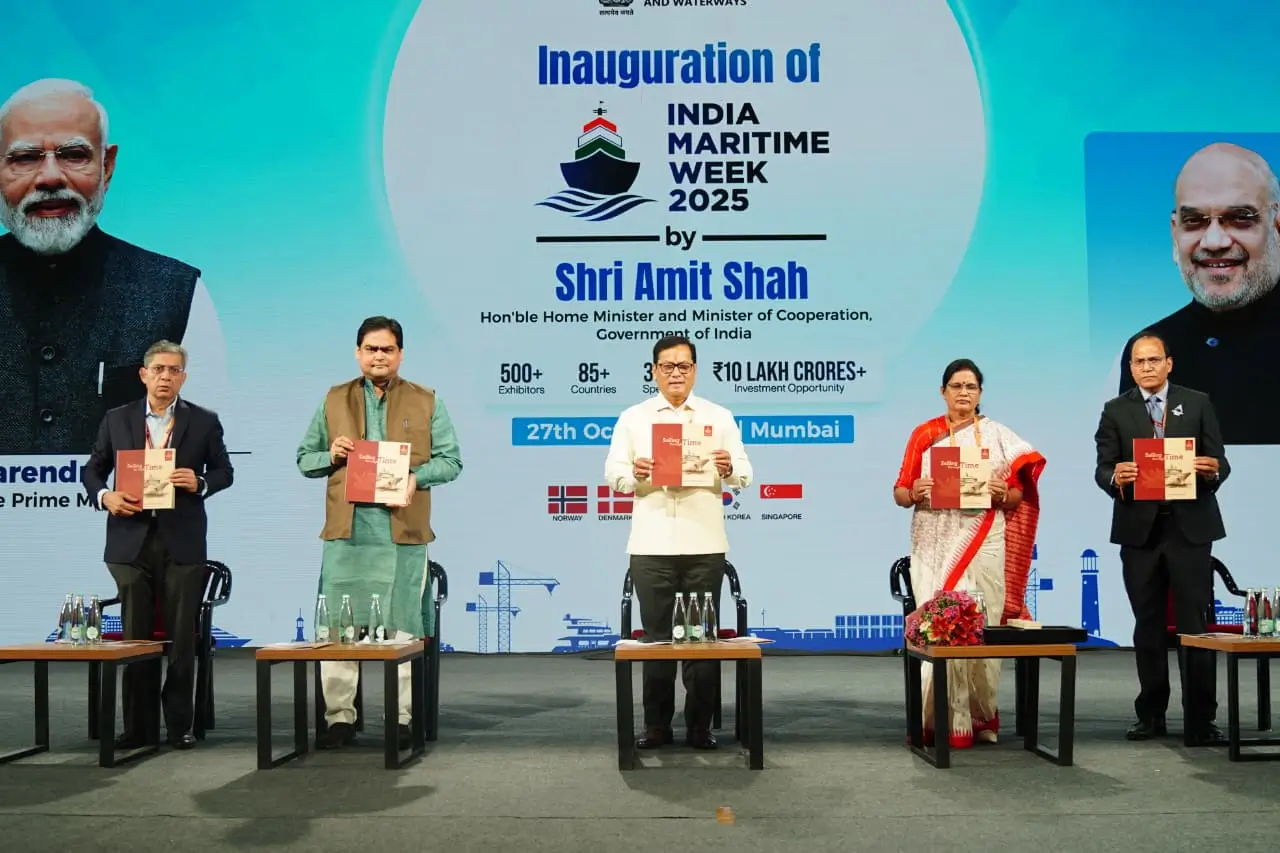
Big names, big signals The opening ceremony inaugurated by Union Home Minister Shri Amit Shah and attended by chief ministers from coastal states Maharashtra, Gujarat, Goa and Odisha. The Prime Minister is scheduled to speak at a plenary session on 29 October and will chair a global CEO forum bringing industry leaders together for strategic conversations. These high-level participations are deliberate: they signal that the event is an instrument of national economic policy and not simply an industry conference. Expect government leaders to emphasise policy levers that push India from regional player to a true maritime hub, easier port processes, deeper industry collaboration, and improved coastal and inland connectivity. The presence of foreign ministers and delegations from multiple countries also shows IMW 2025 is being pitched as a diplomatic and trade stage as much as an industry one.
Scale: numbers that matter Organisers are forecasting participation on a scale rarely seen in the sector: over 100,000 delegates, representation from more than 85 countries, and several hundred exhibitors and speakers. The event will include more than a dozen flagship conferences, country sessions, state sessions and thematic dialogues, covering topics from ports and shipping to shipbuilding clusters and sustainability. These numbers underline IMW 2025’s role as a magnet for international maritime investment and technical collaboration. Perhaps the most eye-catching figure announced by the ministry is the expectation of over 600 MoUs with investment commitments reportedly totalling more than ₹10 lakh crore — a big-ticket set of pledges that, if delivered, would reshape capital flows into ports, shipbuilding, logistics and coastal infrastructure. That scale of maritime investment would move conversations about India’s role in global shipping from aspiration to material change.
What will be on the program IMW 2025 is built as a layered event: an exhibition; multiple conferences; country and state sessions; and focused dialogues. Flagship events include Global Maritime India Summit (GMIS), the QUAD Ports of the Future conference, Sagarmanthan — The Great Oceans Dialogue, SheEO (women in maritime), and international dialogues such as the UNESCAP Asia-Pacific session. Country sessions planned include Norway, Netherlands, Denmark and Sweden; state sessions feature coastal and riverine states showcasing their port potential. These structured interactions are intended to convert conversation into contracts and maritime investment.
How this ties to India’s maritime strategy Over the past decade India has steadily rebuilt its maritime backbone — expanding port capacity, improving efficiency, and growing coastal and inland transport. Progress in these areas feeds directly into the government’s narrative of transforming the country into a maritime hub that anchors trade corridors and supports a growing blue economy. IMW 2025 will be framed as a showcase of that progress and a field to secure the next round of investment and public-private partnerships. Practically, the event gives state governments and port authorities a stage to advertise investment-ready projects: new terminals, hinterland connections, shipyard expansions and coastal shipping routes. Each project that attracts private capital advances India’s maritime hub credentials while strengthening the blue economy through jobs and maritime services.
What sectors are likely to attract investment Expect attention — and capital — in at least four buckets:
Ports and terminals: capacity upgrades, modern equipment and hinterland connectivity.
Shipbuilding and ship-repair clusters: building capacity that keeps more vessels under Indian flags.
Coastal and inland shipping: modal shift to cheaper and greener coastal freight, which strengthens the blue economy and reduces road congestion.
Green shipping and technology: bunkering infrastructure, cleaner fuels, digital port systems and logistics tech that reduce emissions and speed cargo flows. Each of these areas maps to clear maritime investment opportunities and will be central to trade and policy dialogue at IMW 2025.
Green shipping and the blue economy: not afterthoughts Sustainability features prominently in the IMW 2025 programme. Sessions on green and sustainable shipping, along with technical demonstrations and international collaborations, are designed to attract technologies and partners that lower the carbon footprint of port operations and shipping. That intersection economic growth plus environmental care is the essence of a working blue economy approach. Policymakers and investors will be watching which green commitments turn into funded projects and pilot programmes.
Practical outcomes to look for With high-level government attention and organised business matchmaking, there are three practical outcomes to watch during and after IMW 2025: • MoUs turned into projects: announcements are one thing; contract awards and land acquisitions are another. The ability to convert Memorandums into funded, shovel-ready projects will determine whether the event truly ushers in maritime investment at scale. • Foreign partnerships and technology transfer: country sessions and international delegates aim to secure technical cooperation in shipbuilding, digital port operations and clean fuels. These partnerships help India build long-term capacity for a competitive maritime hub. • Policy clarity: investors prize clear, stable rules. Signals from the central and state governments—on land use, taxes, port tariffs and coastal regulations—will affect investment velocity in the blue economy and port projects.
A quick look at the sector’s recent trajectory The past decade has seen measurable shifts: port capacity and cargo throughput have improved, inland waterways have gone from niche to material, and financial performance of ports has strengthened. These structural gains provide the runway IMW 2025 needs to translate enthusiasm into capital flows. The event will be judged on whether it turns this momentum into real projects, new private-sector bets, and durable partnerships.
Who should follow IMW 2025 — and why Students, young professionals and maritime practitioners should watch IMW 2025 for job trends and emerging specialities: green shipping, port tech, logistics analytics and coastal shipping operations. Investors and policy analysts should track which MoUs are followed by firm orders and financing. For port authorities and state leaders, the event is a platform to showcase readiness and attract the kind of maritime investment that builds long-term capacity. Events this large feel part fair, part diplomatic summit, and part contract bazaar. If you’re heading to Mumbai for IMW 2025, bring curiosity and a clear ask: whether you represent a project, a technology, or a hiring need, the week’s purpose is to match problems to capital and expertise. That’s how a gathering becomes a turning point, and how a country turns aspiration into a true maritime hub and resilient blue economy.
On October 25–26, 2025, the Indian Coast Guard completed a coordinated sea rescue operation that saved 31 fishermen who had been adrift for 11 days in the Arabian Sea. The disabled fishing boat, Sant Anton-1, suffered a steering failure and drifted a long distance before being sighted by an aircraft and reached by the Coast Guard ship ICGS Kasturba Gandhi. The rescued crew were evacuated, given medical checks, and the disabled boat was secured and towed to Honnavar harbour.
How the situation unfolded
The fishing boat Sant Anton-1, which fishes out of Goa, was last reported about 100 nautical miles off New Mangalore and was officially reported missing on October 24, 2025. Adverse weather in the region, strong winds and rough seas hampered early location efforts and caused the vessel to drift for days. The Indian Coast Guard launched a search operation that combined aerial surveillance, surface craft, and real-time weather drift modelling.
A Dornier aircraft from the Coast Guard’s Kochi base sighted Sant Anton-1 on October 25, and the on-patrol offshore patrol vessel ICGS Kasturba Gandhi was diverted to the boat’s updated position. Using live meteorological inputs, the Coast Guard plotted the probable drift path and directed search assets to the most likely area a key example of modern sea rescue planning.
When ICGS Kasturba Gandhi reached the scene, the crew found the fishing boat with steering gear failure and the fishermen on board fatigued but alive. The Indian Coast Guard evacuated the fishermen adrift, performed damage assessment of the vessel, assisted with watertight checks, and provided immediate on-site repairs where possible. The Coast Guard’s support included medical screening and basic supplies for the rescued men. The disabled boat was later taken in tow by another fishing vessel to Honnavar fishing harbour.
This chain of actions, aerial spotting, diversion of a patrol ship, evacuation of crew, on-site repairs, and towing of the disabled boat shows the layered capabilities the Indian Coast Guard brings to a complex fishermen rescue scenario.
Conditions that made the mission hard
Weather conditions played a major role in both creating the emergency and complicating the search. Rough seas and heavy winds spread drift trajectories and reduced visibility, making the initial search challenging. The Coast Guard’s use of drift modelling and real-time weather data was essential to narrowing the search corridor and finding the Sant Anton-1 after more than a week at sea. That coordination was decisive in turning a long-running distress case into a successful sea rescue outcome.
Human impact: the fishermen and their ordeal
Being adrift for 11 days is a severe physical and psychological experience. The 31 rescued fishermen faced dehydration risk, exposure to sun and sea, and uncertainty about rescue. The Indian Coast Guard crews who conducted the fishermen rescue provided emergency medical checks and assistance that likely prevented a far worse outcome. Stories like these remind us that maritime professions remain risky, and that timely, capable rescue services are a lifeline for coastal communities.
Several practical lessons come from this incident for operators, regulators, and coastal communities:
Maintenance and checks: Steering gear failure was the initiating technical fault. Regular maintenance and pre-departure checks can reduce such catastrophic failures that leave fishermen adrift.
Communications and emergency beacons: Reliable communications and the use of emergency position-indicating radio beacons (EPIRBs) or satellite messaging could shorten search times and reduce drift exposure.
Drift modelling in search planning: The Coast Guard’s real-time drift predictions show how science and operations must pair in modern sea rescue planning.
Community readiness: Nearby fisheries and small craft provide key support (in this case towing to Honnavar) once immediate risk is resolved, underscoring the value of local coordination for any fishermen rescue.
What authorities did right
The Indian Coast Guard demonstrated core search-and-rescue strengths: rapid deployment of airborne reconnaissance, diversion of an on-patrol ship, use of weather and drift analytics, and coordinated handover to local fishing authorities. The sequence — sighting by aircraft, surface confirmation by ICGS Kasturba Gandhi, evacuation, and towing — is textbook sea rescue response executed under difficult weather conditions. The rescue will likely be used as a case study in regional SAR (Search and Rescue) training.
India’s long coastline and busy fishing sectors make regular fishermen rescue and sea rescue operations inevitable. Incidents like the Sant Anton-1 case highlight the continuing need for investment in coastal safety infrastructure: more effective weather alerting for small boats, wider distribution of EPIRBs, training in emergency seamanship, and stronger links between local fishing communities and rescue agencies. The Indian Coast Guard remains the primary responder, but reducing incidents requires a whole-of-sector approach.
Advice for fishers and coastal communities
For fishers and small-boat operators, common-sense precautions save lives: check steering and propulsion systems before leaving port, carry a working GPS and an EPIRB or satellite communicator, file a float plan with local harbour authorities, and maintain weather awareness. When an engine or steering failure happens far offshore, early distress alerts sharply increase the chances of a timely sea rescue. The recent fishermen rescue is a clear reminder of that reality.
The Indian Navy coordinated a major sea rescue and firefighting operation after the MT Falcon, a fully loaded LPG tanker, suffered an explosion and erupted in flames roughly 116 nautical miles east of Aden in the Gulf of Aden. The incident left the LPG tanker adrift and prompted an international response that included merchant ships, naval units and salvage teams. The Indian Navy later recovered the bodies of two missing crew members after boarding the burning MT Falcon to carry out damage assessment and recovery work.
Timeline and immediate facts
The blast aboard the MT Falcon occurred on October 20, 2025, while the ship was transiting in the Gulf of Aden. The vessel was carrying 26 people and was fully laden with liquefied petroleum gas a volatile cargo that made firefighting urgent and complicated. Passing merchant vessels rescued most of the crew, and international naval coordination helped move survivors to safety. The Indian Navy ship INS Trikand arrived to coordinate firefighting, board the damaged LPG tanker, and carry out recovery and medical assistance.
Rescue, firefighting and recovery actions
Merchant ships in the area initially rescued 24 crew members; they were later landed at Djibouti with the help of naval escorts. The sea rescue phase prioritized saving lives and keeping other ships clear of the burning MT Falcon. After survivors were safe, the Indian Navy focused on firefighting and salvage support. INS Trikand worked with a salvage tug hired by the ship’s owners, conducting coordinated firefighting actions to bring the blaze under control and stabilize the LPG tanker for further operations.
Once the fire was sufficiently suppressed, a specialized team from the Indian Navy boarded the MT Falcon. They worked in extreme conditions intense heat, damaged structures and toxic fumes and recovered the remains of two crew members who had been reported missing after the initial evacuations. The Indian Navy handed the recovered remains to the Indian Embassy in Djibouti for further action and repatriation protocol. This phase of the mission emphasized the grim realities of maritime emergencies involving gas cargoes.
Cause under investigation — attack or accident?
Initial reports suggested the MT Falcon may have been struck by an unknown projectile, but authorities later said they could not yet confirm the source of the blast and did not rule out an onboard accident. The incident was initially flagged by UK Maritime Trade Operations and later reclassified as an advisory while investigations continue. The ambiguity over cause whether hostile action or technical failure adds geopolitical and legal complexity to the response around this LPG tanker casualty.
Vessel background and operational questions
Analysts and open-source trackers flagged questions about the MT Falcon’s recent activity. Reports indicated the ship loaded Iranian LPG at Assaluyeh on September 25, 2025, and may have been bound for Ras Isa in Yemen. Tanker Trackers and others noted the vessel’s age, a prior detention for deficiencies earlier in 2025, and the lack of a known insurer factors that raise operational and regulatory concerns for a ship carrying hazardous cargo in a tense region. Those details shaped how rescue and salvage teams approached the damaged LPG tanker.
International coordination and maritime security context
The response combined merchant initiative, multilateral naval support and regional coastguard actions a typical pattern when incidents occur in the Gulf of Aden. EUNAVFOR ASPIDES and UN-linked maritime reporting centres helped coordinate initial search and rescue responses, while naval escorts safeguarded rescued seafarers en route to port. The sea rescue sequence shows how civilian and naval actors converge rapidly to save lives, then shift to firefighting and investigation tasks. In a region with a history of attacks on shipping, such coordination is essential.
There are clear practical lessons from the MT Falcon case for ship operators, mariners and students:
Carrying volatile cargo like LPG demands stringent maintenance, up-to-date safety equipment and well-drilled emergency plans.
Rapid distress signalling and immediate assistance from nearby vessels were crucial in the early sea rescue phase.
Salvage operations for an LPG tanker require specialized tugs, firefighting expertise and careful risk assessment before boarding.
Vessel vetting, insurance status and prior deficiency records matter hugely when an emergency unfolds; older or detained ships complicate rescue and legal follow-up.
Human cost and crew welfare
Beyond technicalities, the story is about people: crew members pulled from lifeboats, families waiting for news, and naval teams risking heat and fumes to recover the missing. The Indian Navy’s role in both saving lives and recovering remains underscores the emotional weight of maritime incidents. Post-incident, proper medical care, repatriation and counselling for survivors and bereaved families are immediate priorities. The human toll should also push shipowners and regulators to redouble safety precautions aboard LPG tanker operations.
Investigations will aim to determine whether the MT Falcon’s explosion was caused by an external strike or an internal accident. Salvage specialists will continue stabilising or removing hazard from the LPG tanker, while authorities review documentation, crew statements and sensor data. For maritime stakeholders and students, this incident will be studied for lessons on risk management, regional security impacts, and the importance of coordinated sea rescue capabilities when hazardous cargoes are involved.
The burning of the MT Falcon in the Gulf of Aden is a reminder that shipping carries risk as well as reward. The Indian Navy and merchant crews who helped in the sea rescue deserve recognition for saving lives and facing danger to recover the missing. For the maritime community, the event asks a simple question: how do we make sure every LPG tanker voyage is as safe as it can be — for crew, for rescuers, and for the sea itself? That question matters more than headlines.
On 15 October 2025, The New Mangalore Port Authority celebrated a major milestone as the NMPA Golden Jubilee curtain-raiser was held at Bharat Mandapam. Union Minister for Ports, Shipping and Waterways Shri Sarbananda Sonowal inaugurated the event and launched eight new projects designed to upgrade the port’s facilities, improve user convenience, and strengthen local healthcare and logistics. The minister also launched a commemorative postal stamp, a coin and the official Golden Jubilee anthem.
This anniversary is not only symbolic. The New Mangalore Port Authority has come a long way since it opened in 1975. Last year it handled 46.01 million tonnes of cargo, and its total capacity now stands at 104 million tonnes per year. The NMPA Golden Jubilee events are a chance to highlight that growth and lay down the next set of steps to upgrade maritime infrastructure around the port.
Eight practical projects
The eight projects announced at the NMPA Golden Jubilee are practical upgrades that respond to day-to-day port needs. They include construction of two covered storage sheds with 14,000 MT capacity, a dedicated cruise gate for tourists, and modification of the KK Gate with RFID-enabled cargo handling and customs facilities. Truck parking terminals are being expanded at the Customs House and Baikampady, and PQC roads are planned at the MDL yard. A major social investment is a 150-bed multi-speciality hospital to be built under PPP with ₹107 crore of investment, along with a dedicated medical app for beneficiaries. These initiatives strengthen core maritime infrastructure and user services around the port.
Each project is intentionally hands-on: covered sheds ease cargo handling in wet weather; the cruise gate supports tourism and international passengers; RFID upgrades smooth customs and security; and truck terminals reduce congestion and waiting times. Together they make the New Mangalore Port Authority more efficient and friendlier to businesses and communities.
How this links to national plans – Sagarmala projects and Vision 2047
Minister Sonowal placed the local projects in a national frame by linking them to the Sagarmala programme and the larger Maritime Amrit Kaal Vision 2047. He reminded listeners that under Sagarmala, 840 projects worth ₹5.8 lakh crore are planned by 2035, with 272 projects completed and 217 ongoing. These Sagarmala projects are the government’s instrument to modernize ports, expand capacity and improve logistics across India — and the NMPA upgrades are an example of how Sagarmala projects translate into local action.
The minister further argued that ports will be central to India’s aim of becoming a $30 trillion economy by 2047. He stressed that to be a “Viksit Atmanirbhar Maritime Nation,” India must invest in resilient maritime infrastructure and sustainable port practices — the same priorities reflected in the new projects at NMPA.
Green and tech-focused measures
Environmental and technology measures were highlighted during the ceremony. The minister praised NMPA’s green operations and pointed to national initiatives such as the Harit Sagar Guidelines, Green Tug Transition Programme, Harit Nauka Scheme and Green Shipping Corridors. These programmes are meant to reduce emissions, electrify vessel operations and promote cleaner fuels — a direction that will shape future maritime infrastructure upgrades. The NMPA Golden Jubilee therefore doubles as a platform to show how local ports are aligning with green objectives in practice.
The event also stressed digital steps such as RFID-enabled gates and improved customs handling. These small but concrete technology upgrades make port operations swifter and reduce waiting time for trucks and ships, an operational benefit that flows directly into lower costs and faster turnaround for exporters and importers.
Practical investments like storage sheds and truck parking reduce losses and disruptions for exporters and hinterland transporters. The planned hospital and medical app show an emphasis on social infrastructure for port workers and their families. In short, the New Mangalore Port Authority projects are not just about moving cargo — they are about improving the local ecosystem that supports maritime trade. The NMPA Golden Jubilee spotlight therefore includes both economic and human outcomes.
For local businesses and logistics operators, better truck terminals and PQC roads mean less time lost in congested queues and improved predictability. For workers, the hospital and medical app bring improved access to healthcare. These kinds of concrete benefits are often what turns announcements — including many Sagarmala projects — into real, lived improvements.
The important measures to track after the NMPA Golden Jubilee are execution and delivery. Announcements and ceremonial launches are the first step; timely construction, fair procurement, and efficient operations will determine whether these projects actually strengthen maritime infrastructure. Stakeholders should also watch how the hospital PPP is structured and how quickly RFID and other digital upgrades are integrated into daily port operations. The successful conversion of Sagarmala projects into completed facilities at ports like New Mangalore will be strong evidence of progress on the ground.
A port’s anniversary is partly nostalgia and partly planning for the future. At the NMPA Golden Jubilee, ceremonial acts — stamps, coins and songs — met practical project launches that will affect real work and real lives. For students, maritime professionals and local residents, the message is clear: ports are more than steel and cranes; they are ecosystems of people, services and infrastructure. If the New Mangalore Port Authority can deliver on these projects, the result will be better logistics, healthier communities and a stronger regional role in India’s broader Sagarmala projects and maritime ambitions.
India Maritime Week (IMW) 2025 is set to become one of the most significant maritime events in the country’s history, showcasing India’s ambitions to become a global maritime leader. The event, to be held at the Bombay Exhibition Centre in Mumbai, will bring together global and domestic stakeholders to explore opportunities in the maritime sector, with a focus on innovation, sustainability, and investment.
The Union Minister of Ports, Shipping & Waterways, Sarbananda Sonowal, along with Maharashtra Chief Minister Devendra Fadnavis, Deputy Chief Minister Ajit Pawar, and Minister of Ports Development Nitesh Narayan Rane, recently reviewed preparations for the mega event. The meeting, held at Mantralaya in Mumbai, assessed venue readiness, logistics, security, and stakeholder coordination to ensure the seamless execution of the upcoming India Maritime Week 2025.
Prime Minister Narendra Modi will attend the event and deliver the keynote address at the Global Maritime CEO Forum, underscoring the national importance of IMW 2025 in India’s vision to lead the global maritime landscape.
A High-Level Review to Ensure Readiness
The review meeting was attended by senior officials from the Ministry of Ports, Shipping & Waterways (MoPSW) and the Government of Maharashtra. The leaders emphasized the importance of Mumbai’s preparedness as the host city, focusing on infrastructure, safety, and coordination among agencies.
Union Minister Sarbananda Sonowal expressed confidence in the ongoing preparations, stating that under the leadership of Prime Minister Narendra Modi, the maritime sector is undergoing rapid transformation. The review also highlighted the government’s goal to position Mumbai as a global hub for maritime innovation, investment, and collaboration, aligning with India’s broader maritime and blue economy vision.
Speaking after the meeting, Sarbananda Sonowal shared the government’s long-term goals for the maritime sector. He said,
“Under the dynamic leadership of Prime Minister Modi, we are transforming our ports, shipping, and logistics ecosystem into one that is resilient, sustainable, and future-ready. This opens vast avenues for international collaboration, including a 1 trillion US dollars maritime investment roadmap.”
Sonowal added that India Maritime Week 2025 will serve as a crucial platform to turn ideas into action, where policy discussions evolve into concrete projects and collaborations.
He emphasized that India’s maritime vision for 2047, aligned with the broader national vision of Viksit Bharat 2047, focuses on prosperity, sustainability, and pride in India’s maritime heritage. According to Sonowal, India is on track to attract ₹8 trillion in investments by 2047, which will generate 1.5 crore new jobs across the maritime and allied sectors.
Progress and Achievements in the Maritime Sector
India’s maritime sector has made remarkable progress in the last decade. The country’s ports and shipping infrastructure are being modernized to meet global standards while emphasizing environmental sustainability. Key achievements shared during the briefing include:
Cargo movement on inland waterways has grown eightfold since 2014.
Turnaround time at major ports has improved significantly, reducing by nearly 60%.
Over ₹5.5 lakh crore worth of Sagarmala projects are currently reshaping India’s coastal logistics network.
India has emerged as a global seafaring leader, contributing 12% of the world’s seafarers.
All 12 major Indian ports are set to achieve carbon neutrality by 2047, with major progress toward green energy transition goals for 2035 already underway.
These milestones highlight India’s evolving maritime strength, balancing growth, efficiency, and sustainability.
IMW 2025: Scale, Participation, and Global Collaboration
India Maritime Week 2025 is expected to be one of the largest maritime gatherings ever organized in India. The event will host:
Over 100,000 delegates
More than 500 exhibitors
Representation from over 100 countries
The summit will attract ministerial delegations from Singapore, the UAE, South Korea, Japan, and Denmark. In addition, leading international organizations, including the International Maritime Organization (IMO) and the United Nations Economic and Social Commission for Asia and the Pacific (UNESCAP), will take part.
Several Indian states like Maharashtra, Gujarat, Kerala, and Tamil Nadu will also showcase their maritime and port development initiatives. Major private and public sector companies such as Adani Ports and Logistics, Cochin Shipyard, and Paradip Port Authority are set to exhibit their innovations, investments, and partnerships.
Thematic Focus: Innovation, Sustainability, and Global Partnerships
IMW 2025 will not just be an exhibition but a strategic forum for dialogue and collaboration. Its agenda covers the entire maritime ecosystem, including:
Port modernization and connectivity
Shipbuilding and ship repair
Green ports and clean energy initiatives
Coastal and inland waterway logistics
Maritime digitalization and technology adoption
Global trade and blue economy development
The event aims to foster collaboration between governments, industry, and academia, encouraging innovative solutions to shape the future of India’s maritime and logistics infrastructure.
Sarbananda Sonowal emphasized that India stands ready to lead and collaborate toward a maritime future that is prosperous, sustainable, and inclusive.
Mumbai – The Host City for Maritime Transformation
Mumbai, known as the “Maximum City,” will play a central role in hosting IMW 2025. Sonowal described it as the city that will “unlock maximum opportunities and maximize possibilities” during the event.
As India’s largest port city and financial hub, Mumbai’s hosting of IMW 2025 is symbolic. It reflects the city’s growing importance in maritime trade, logistics, and industrial growth. The event will further strengthen Maharashtra’s position as a maritime gateway, creating new opportunities for both public and private stakeholders.
Strengthening Global Maritime Leadership
With IMW 2025, India seeks to strengthen its global standing in the maritime domain. The event’s vision aligns with two major policy frameworks:
Maritime India Vision 2030 – A strategic plan to enhance port capacity, logistics efficiency, and coastal community development.
Amrit Kaal Maritime Vision 2047 – A futuristic roadmap for achieving carbon neutrality, digital integration, and global competitiveness in the maritime sector.
By aligning with these long-term frameworks, IMW 2025 aims to establish India as a trusted maritime partner, driving innovation and sustainability in global trade and logistics.
India Maritime Week 2025 will act as a policy platform where decision-makers, investors, and industry leaders can collaborate. Sessions will likely cover:
Future trade corridors and shipping routes
Maritime finance and insurance
Port-led industrialization and coastal development
Skill development and workforce opportunities
Green shipping initiatives and ESG (Environmental, Social, and Governance) standards
With participation from over 100 countries, IMW 2025 will provide a global view of how nations can cooperate to build a secure, resilient, and inclusive maritime ecosystem.
Steering Toward a Maritime Future
India’s maritime ambitions are entering a decisive phase. The upcoming India Maritime Week 2025 is more than just an event, it reflects India’s growing confidence, capability, and commitment to leading in the maritime space.
By combining ₹8 trillion in investment, 1.5 crore new jobs, and a clear vision for sustainability and digital transformation, India aims to anchor its position as a global maritime leader by 2047.
As the world’s attention turns to Mumbai for IMW 2025, the event promises to serve as a milestone in India’s journey toward becoming a key player in the global blue economy, where innovation, collaboration, and progress converge on a common horizon.
When you hear “ports”, you often think of ships, cranes, and containers. But what if ports could also become engines for clean energy? That’s exactly what India has embarked upon. On 10 October 2025, the Ministry of Ports, Shipping and Waterways officially recognised three major ports as Green Hydrogen Hubs under the National Green Hydrogen Mission (NGHM).
The ports selected are:
Deendayal Port Authority (Gujarat)
V.O. Chidambar Anar Port Authority (Tamil Nadu)
Paradip Port Authority (Odisha)
This move signals that ports are not just gateways for goods, they can become nodes in India’s clean energy transition.
Let’s dive in.
What Is the National Green Hydrogen Mission?
The National Green Hydrogen Mission (NGHM) is India’s roadmap to becoming a global hub in the production, utilization, and export of green hydrogen and its derivatives. Green hydrogen is generated from renewable energy sources with no carbon emissions, making it a vital clean fuel option for heavy industry, shipping, and other sectors.
The Mission focuses on creating hydrogen hubs. Areas where production, consumption, infrastructure, and logistics are co-located to lower costs, boost efficiency, and enable large-scale viability.
In June 2025, revised guidelines under Component B2 allowed certain locations to be recognised as Green Hydrogen Hubs even without direct financial assistance. That is, states or authorities can obtain recognition and benefit from incentives under other schemes.
Why These Three Ports?
The strategic location and connectivity of these ports are key. They play a central role in trade, energy flows, and logistics, with strong access to hinterlands, industrial hubs, and major routes. Identifying them as green hydrogen hubs maximises current maritime infrastructure.
The Mission’s design emphasizes cluster-based development, meaning the hydrogen ecosystem (production, storage, usage) should be geographically reasonable. Ports naturally lend themselves to cluster formation because they already have infrastructure, land, and connectivity.
Because of the revised guidelines, these ports now can access incentives and benefits under central and state-level schemes linked to green hydrogen, even if the port itself isn’t getting direct funding. This recognition is a signal to industry: “you can invest here with support.”
Union Minister Sarbananda Sonowal highlighted that ports are critical nodes in India’s transition to sustainable logistics, especially given their strategic location on eastern and western trade corridors.
Once recognised, ports qualify for incentives, which can accelerate investment in hydrogen production facilities, electrolysers, hydrogen storage, and related sectors such as ammonia and methanol manufacturing. This growth paves the way for significant job creation.
Ports deal with heavy emissions: ships, trucks, cranes. If the hydrogen produced locally can power port operations or cleaner fuel bunkering, logistics become more sustainable. This aligns with global pressure to decarbonize maritime transport.
With global demand for green hydrogen rising, India could become an exporter of hydrogen or hydrogen-based fuels. Ports designated as hubs give physical gateways for export. India could move from being an energy importer to a clean energy competitor.
Grouping infrastructure elements such as pipelines, storage, and connectivity can reduce the cost of hydrogen per unit. Achieving scale is crucial for hydrogen, especially as it faces significant cost obstacles today.
Each of the three ports is in a different part of India — Gujarat, Tamil Nadu, Odisha. Recognizing them as hubs can spread clean energy benefits across regions, not just in one zone.
Challenges & Risks to Watch
Establishing hydrogen infrastructure requires significant investment in electrolysers, pipelines, storage, and safety systems. Securing initial funding and managing risk can be challenging. Producing green hydrogen depends on stable renewable energy sources such as solar or wind. Ports and nearby areas must ensure proper grid integration or have access to dedicated renewable power.
Hydrogen is tricky to transport. Its low density, needs compression or liquefaction. Even within the port cluster, getting hydrogen from production to usage points might involve technical challenges.
Hydrogen projects require safety measures, regulatory approvals, environmental clearances, and coordination between government agencies. Additionally, early offtake agreements are necessary to ensure buyers in sectors like industry, shipping, and mobility.
How This Fits into India’s Clean Energy Trajectory
This action reflects a wider trend in India’s climate and energy policy.
India has pledged net zero by 2070. Green hydrogen is one of the tools in the toolbox.
The government is trying to localize manufacturing of solar, batteries etc. Hydrogen hubs at ports help integrate energy and industrial supply chains.
Policy updates such as the June 2025 guidelines demonstrate increased flexibility and acknowledge private sector initiatives even when there is no direct funding.
With ports as hubs, India is combining two levers, clean energy and maritime infrastructure, which historically are critical to economic growth.
What This Means for Students, Professionals & Stakeholders
Maritime professionals: Ports could become hydrogen bunkering centres. Understanding hydrogen logistics, safety, and integration will be a valuable skill.
Energy / clean tech students: You can watch how renewable power, hydrogen, and industrial demand integrate. These ports may serve as case studies.
Policy & planning: The government’s model is hybrid, combining cluster planning with incentive frameworks. Observing what works/what doesn’t will shape future zones.
Investors & startups: Early entry into hydrogen value chain around these ports could pay off if infrastructure and demand align.
This recognition of three major ports as green hydrogen hubs under the National Green Hydrogen Mission is bold and hopeful. It signals that India is serious about set in clean energy into its infrastructure, not keeping it at the margins.
Still, this is a first step, not a finish line. Whether these ports succeed in creating viable hydrogen clusters depends on investment, demand, regulatory clarity, and technical execution.
On 6 October 2025, the Government of India marked a significant milestone in the country’s maritime journey: the induction of VLGC Shivalik under the Indian flag. This event welcomed by Union Minister Shri Sarbananda Sonowal at Visakhapatnam Port symbolises India’s commitment to maritime atmanirbharata (self-reliance in shipping). It also signals a push toward becoming a top-tier maritime nation by 2047, in line with the Maritime Amrit Kaal Vision 2047.
This detailed development has implications for India’s energy security, shipbuilding sector, foreign exchange savings, and national prestige in the global maritime domain.
What is VLGC Shivalik?
VLGC stands for Very Large Gas Carrier. The Shivalik is the third VLGC inducted into India’s Shipping Corporation of India Ltd. (SCI) fleet. It joins two others: Sahyadri and Anandamayi.
Some technical and operational highlights:
Capacity: 82,000 cubic metres (CBM)
Length: 225 metres
Built in South Korea
Features: segregated tanks, advanced temperature control, global safety & efficiency compliance
Maiden voyage: Loaded over 46,000 metric tonnes of LPG (propane + butane) in Ruwais (UAE), then delivered to Visakhapatnam for Indian Oil Corporation Ltd. (IOCL)
By bringing Shivalik under Indian ownership and flag, the government underscores its increasing ambition in global energy trade and maritime presence.
India imports significant quantities of LPG for domestic consumption. Having a VLGC like Shivalik under the Indian flag ensures safer, more reliable transportation of that fuel. It deepens energy connectivity with the Arabian Gulf, reducing dependence on foreign shipping lines.
The government aims for more Indian-flagged vessels carrying its cargo. Shivalik’s induction is a step toward that. Minister Sonowal framed it not merely as fleet expansion but as a confidence statement in India’s shipping resurgence and its capability to compete globally.
One of the bold claims: by 2047, joint ventures (JVs) between SCI and oil PSUs planning to build 112 vessels will save about $75 billion (₹6 trillion) in freight costs otherwise paid to foreign lines annually.
The government is concurrently pushing policies to stimulate domestic shipyards, repair, recycling, design, and financing. These will create high-quality employment, strengthen the supply base, and reduce cost disadvantages for Indian shipbuilders.
India as a holistic maritime ecosystem can design, build, finance, own, repair, recycle. – Sarbananda Sonowal
Under Prime Minister Modi’s leadership, the government is charting a course toward positioning India among the world’s top five maritime powers by 2047. The induction of Shivalik is portrayed as one tangible milestone in that trajectory.
Expand domestic shipbuilding capacity (target: 4.5 million gross tonnage annually)
Infrastructure status & tax / duty incentives
—
Infrastructure status for large vessels; customs duty exemptions on components; extension of tonnage tax to inland vessels
These initiatives aim to level the playing field for Indian shipyards, reduce cost handicaps, attract investments, and promote innovation in green shipping and recycling.
On-the-Ground
The event at Visakhapatnam saw a gathering of dignitaries:
Union Minister Shri Sarbananda Sonowal
Visakhapatnam MP and MLA
Chairman of Visakhapatnam Port Authority
SCI Chairman & Managing Director
Capt. Bhaskar Tandon (Master of Shivalik) & other maritime officials
They toured critical parts of the vessel like navigational bridge, cargo control room guided by Capt. Tandon and Chief Officer Vivek Tyagi.
Sonowal addressed the 29-member crew, praising them as ambassadors of India’s maritime strength and signalling that this vessel is more than infrastructure it is symbolic of India’s resolve.
In his speech, Sonowal called this moment a “writing of a new chapter in India’s maritime destiny”, “under the proud tricolour, with confidence, courage, conviction.”
This is an ambitious path. Some tensions and challenges worth reflecting on:
Global competition & cost pressures: Indian shipyards have long faced cost disadvantages versus East Asian yards (Korea, China, Japan). The policy support is necessary but not always sufficient.
Execution & timeline: The targets (112 vessels, large annual tonnage, top 5 maritime ranking) require disciplined planning, timely delivery, project management, and continued funding.
Sustainability & green transition: As global shipping leans toward low-carbon fuels, hydrogen, ammonia, etc., India must adapt its vessel design, fuel infrastructure, and regulatory standards.
Manpower & skills: Scaling up ambitious shipbuilding and operations will require thousands of skilled workers, engineers, designers, and maritime professionals.
Geopolitical & energy risks: Energy supply routes, maritime chokepoints, and global LNG / LPG markets are volatile; India must hedge risks.
While these factors don’t diminish the ambition, they do highlight the practical complexities involved in pursuing “maritime atmanirbharata.”
What It Means for Students & Maritime Professionals
If you are in maritime studies, naval architecture, marine engineering, logistics, or shipping management, here’s what to watch –
Demand for skills in ship design, marine electronics, systems integration, green fuels will grow.
Opportunities may arise in ship repair, recycling, retrofitting as India expands its domestic cluster.
Policy reforms (tax, infrastructure, incentives) may change investment flows; staying updated will be key.
New ventures, JVs, and private sector partnerships may open doors in shipping operations, financing, and R&D.
For those in policy, economics, or shipping law, India’s push into flag tonnage and regulation may open interesting career niches.
The induction of VLGC Shivalik under the Indian flag is more than a one-off ceremony. It stitches into a pattern, a narrative of confidence, capability, and ambition in the maritime domain. The government is backing that narrative with real financial instruments (MDF, SBFAS, SbDS), policy levers (tax breaks, infrastructure status), and strategic vision (112 vessels, top 5 maritime by 2047).
Ambition requires discipline, humility, and adaptability. Shivalik now marks India’s active commitment to expanding its maritime presence with assets, policies, and determination.
In late September 2025, Karandeep Singh Rana, a 22-year-old merchant navy cadet from Dehradun in Uttarakhand, missing during a voyage in the Indian Ocean. Karandeep was working as a deck cadet (a trainee officer) on board the oil tanker Front Princess, operated by Singapore-based Executive Ship Management. The tanker was en-route from Iraq to China via Sri Lanka and Singapore. According to family accounts and company statements, Karandeep was last heard from on the morning of September 20, when he spoke with his parents and seemed “perfectly fine”. By evening that day, the company in Mumbai informed Karandeep’s family that he had gone missing from the ship and was not found despite extensive searches. In other words, the young cadet was missing at sea off the Sri Lankan coast.
After the disappearance was reported, the oil tanker and Sri Lankan authorities launched a massive 96-hour search operation. They searched a wide area off Sri Lanka for days but found no sign of Karandeep on or near the vessel. Only a single shoe and Karandeep’s personal camera were recovered from the ship during the search. The ship’s crew helped in the search while Sri Lankan naval helicopters and ships patrolled the waters, but despite these efforts Karandeep could not be found. In a statement, the shipping company said it was “with profound sadness” that it announced the “tragic loss” of Cadet Rana, suspecting he was lost overboard on the night of September 20. The tanker then continued to China, where authorities planned a formal investigation once it arrived.
The Missing Cadet and Ship Details
Karandeep Singh Rana was a senior deck cadet – a trainee officer nearing the end of his education – in the Merchant Navy. At 22 years old, he had already served on two ships with the same company (Executive Ship Management) and was on track to become a Third Officer, according to his father. He is from Dehradun and had dreamed of a seafaring career. On the unfortunate voyage, Karandeep boarded the tanker Front Princess in Singapore. The Front Princess is a 95,000-ton oil tanker that had sailed to Iraq before making the return journey toward China, stopping near Sri Lanka on the way.
Karandeep’s disappearance is highly unusual, especially for a trained officer who had no known prior incidents. His father, Narendra Singh Rana, told press that he had been in regular contact with Karandeep during the journey and heard from him on the morning of Sept 20. Later that evening, the company called to say Karandeep had vanished. At that point, no emergency (Mayday) signal had been sent, nor was there any immediate explanation given. Family members were “shocked” after receiving the news, since their last conversation was normal. The company initially only reported that Karandeep “had gone to the deck alone and had been missing since then”.
Officials say the ship’s crew was cooperative, but by the time of the notification it was already dark and the ship had moved on. The tanker’s management in India quickly launched search measures, However, the sheer of the ocean made locating a single person very challenging. The site of the disappearance was near busy shipping lanes in the Sri Lanka–Singapore corridor, yet no other vessel reported seeing any incident. The Front Princess had logged Karandeep as safely onboard at the start of that watch, according to company records, but something happened after that time.
Following the report of Karandeep’s disappearance, the shipping company and Sri Lankan authorities organized a large-scale search-and-rescue (SAR) operation. In accordance with international maritime conventions, when a seafarer goes missing, nearby vessels and coastal states coordinate to search the last known area. Sri Lanka, being closest, sent military helicopters and patrol boats to search the waters around the tanker’s route. The tanker crew also turned back briefly to look. In total, about 96 hours of searching were carried out. Teams checked the sea surface and the ship itself multiple times. Despite this effort, they found only the cadet’s shoe and a camera – no sign of Karandeep.
This recovery of personal items suggests he fell or left the ship somehow, but the absence of other clues has made the case puzzling. The crew examined life rafts, safety gear and the deck, and the ship’s route, but without result. No broadcasted distress call or sighting of a person in the water was reported during the search period. Sri Lankan authorities eventually had to stand down the official SAR after four days, as no trace of Karandeep was found beyond the items noted. The tanker then proceeded on its scheduled route.
The shipping company’s statement acknowledged the intensive search. In the Times of India report, the company spokesperson explained: “the ship’s crew searched for Karandeep for four days, and the Sri Lankan defence helicopters and other vessels also assisted in the search. Sadly, he could not be found”. They also noted that a formal investigation will be conducted once the vessel arrives in China, its destination port. This is standard practice, the flag state or port state authorities would examine ship logs, CCTV, and interview crew to establish what happened.
Currently, there is still no final explanation for Karandeep’s disappearance. The company suggests that he most likely fell overboard by accident late on September 20th. Although rare, accidental falls from merchant vessels can occur due to slips, rough seas, or sudden vessel movements. The search took place far from shore, in open waters. If Karandeep did really fall into the ocean, the combination of strong currents and warm September temperatures would make survival doubtful without immediate rescue. With no further evidence, authorities have classified him as assumed lost at sea until new information arises.
Family Appeals and Reactions
Karandeep’s family has been vocal in seeking assistance. His father Narendra Rana has publicly urged the Uttarakhand government and India’s Ministry of External Affairs (MEA) to intervene. He even met the Uttarakhand Chief Minister Pushkar Singh Dhami, requesting help in the search and investigation. The family posted pleas on social media, highlighting that they had “not been provided footage” or full information by the company. In one post, Karandeep’s sister called for police and press attention, saying the family was still without answers.
Local and national media covered the story, bringing public attention to the case. Since Karandeep was from Uttarakhand, state officials noted the disappearance. However, because the incident happened in international waters near Sri Lanka, the Indian government’s role is somewhat limited. The MEA typically does not get involved in a commercial shipping case abroad unless Indian interests or safety are at stake, beyond standard diplomatic inquiries. Nonetheless, the Uttarakhand government has offered to coordinate with relevant agencies.
Friends and community members in Dehradun remember Karandeep as diligent and humble. Reports say he had just completed an internship and was about to earn his professional certification. The sudden loss has been devastating for the family. As one report noted, Karandeep “had always wanted to join the Merchant Navy, and he was due to become a Third Officer”. His career at sea was just beginning. The family has asked people to pray for him and has warned against spreading rumours.
Importantly, all involved have appealed for sensitivity. The shipowners clearly warned against speculation, saying emotional reactions could add to the family’s pain. As the company said, “tragic incidents like this are complex and speculation can cause additional distress to both the family and friends of Karandeep”. So far, no one has claimed any wrongdoing; investigators are currently handling the situation as a mysterious disappearance until more information comes to light.
Investigation and Current Status
At the time (October 2025), Karandeep Singh Rana’s destiny is still unknown. The oil tanker Front Princess has sailed on to China, as planned. Once it arrived, port authorities in the destination likely initiated a formal inquiry. This investigation would examine all evidence: ship records, navigation data, watch logs, and any available video footage. The crew members would be interviewed by maritime authorities to piece together Karandeep’s last hours. Executive Ship Management has said this investigation will be “full” and “official,” but no findings have been made public yet.
Because no new details have emerged in open sources, the case remains unresolved in the public eye. There have been unverified online rumours (for example, a social media post claiming Karandeep was found in another country), but none of these claims are confirmed by any credible source. All official reports still present the incident as a tragic overboard disappearance off Sri Lanka. The company and authorities have not reported any rescue of Karandeep or sighting after the September search.
According to international shipping protocols, if a seafarer is not found after thorough searches, he is generally presumed lost. The family, however, has indicated they will continue pressing for answers. They have asked for all possible help from the Sri Lankan authorities (who conducted the search), the Chinese port authority (which oversees the ship now), and Indian diplomats to keep any lead open.
Safety at Sea and Cadet Training
While rare, incidents of crew members going missing at sea do happen in the merchant navy. The life of a seafarer can be isolating and physically demanding. A deck cadet is often responsible for navigation watch, lookout, and routine deck work. Cadets are trained to follow strict safety procedures, including wearing harnesses and using communication devices when on open decks, especially at night. If those procedures fail or are bypassed, the risk of accident increases.
The Sri Lanka–Singapore sea route is one of the world’s busiest shipping corridors. Oil tankers routinely cross these waters on voyages between the Middle East and East Asia. Weather in late September is usually calm, but a sudden slip or a health incident on deck could lead to a fall. The recovered shoe suggests Karandeep may have fallen overboard, but it is not definitive proof. The camera might have been with him on deck.
After this incident, maritime safety advocates have echoed the importance of watch-keeping protocols and emergency drills. Training institutes for merchant navy cadets often stress the dangers of fatigue and the necessity of working in pairs or using safety lines on deck. Each ship also carries equipment like personal locator beacons (PLBs) or life buoys, which could help in such cases – it is not clear if these were deployed or available at the time.
The case has highlighted the emotional strain experienced by the families of seafarers. Sailors spend extended periods away from their loved ones, often making communication challenging. Once a vessel enters international waters, local authorities, apart from those in India, take control during emergencies. For the parents of the young cadet, this situation resulted in anxious waiting as their son’s ship moved farther away.
What Comes Next
In the coming weeks and months, attention will focus on the results of the formal investigation. If investigators determine Karandeep likely fell accidentally, the case will be closed as a tragic loss at sea. If there were any other factors (such as onboard conflict or equipment failure), they would also be reported. Meanwhile, the family has indicated it will follow all paths, including legal and governmental, to get closure.
For now, the human side of this story is front and centre. A promising young merchant navy cadet from Uttarakhand has disappeared, and a family waits anxiously for answers. The Merchant Navy community has offered support, and the public is keeping an eye on developments. Any new official update will be keenly watched by all involved.
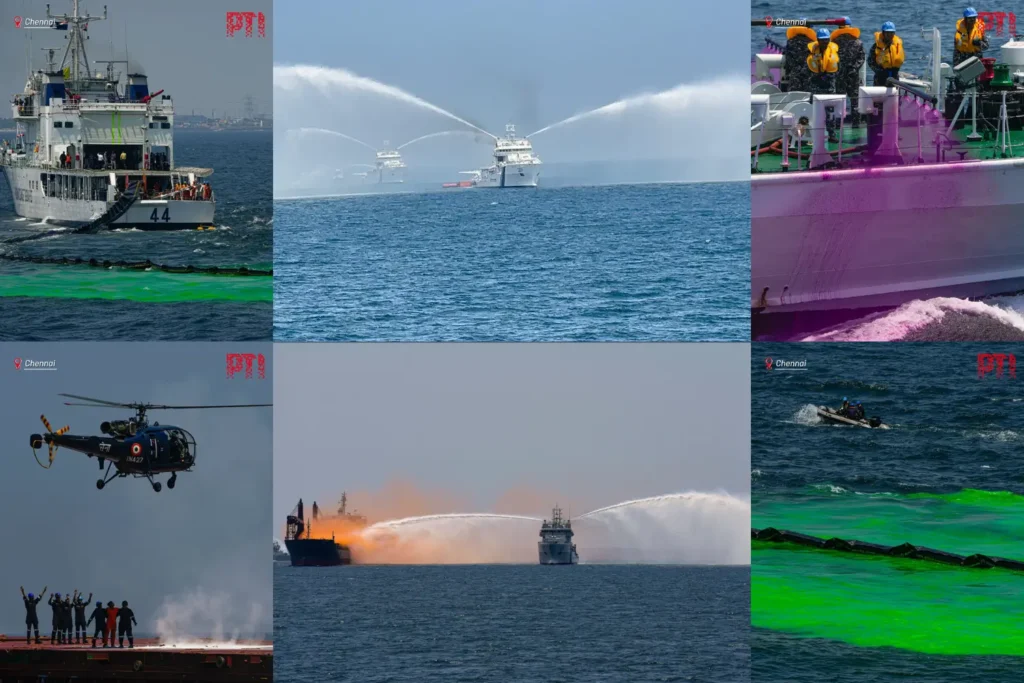
The Indian Coast Guard (ICG) convened a comprehensive national exercise off the coast of Chennai on October 5–6, 2025, combining the 10th National Level Pollution Response Exercise (NATPOLREX-X) with the 27th National Oil Spill Disaster Contingency Plan (NOSDCP) preparedness meeting — a focused push to sharpen the country’s oil spill response and marine pollution preparedness.
The biennial NATPOLREX-X, long established as a core component of India’s marine environmental protection posture, ran in parallel with the NOSDCP review. The combined event drew over 105 national delegates and 40 foreign observers representing 32 countries, creating a rare platform for international knowledge exchange on oil spill response tactics, command-and-control coordination and post-spill recovery strategies.
A standout feature of this edition was the first-ever shoreline cleanup drill at Chennai’s Marina Beach, carried out as part of the simulated incident. Local civic bodies — including the Greater Chennai Corporation, the State Pollution Control Board and State Disaster Management Authority — participated alongside police and other state agencies in a coordinated shore-level response. The Marina Beach drill underscored the reality that oil spill response is not limited to vessels and aircraft: shoreline operations, community mobilization and rapid debris management are critical to mitigating environmental and socio-economic impacts.
Operational demonstrations validated the ICG’s multi-layered pollution response framework. A range of domestic and indigenous platforms were deployed, from Pollution Control Vessels (PCVs) to Offshore Patrol Vessels (OPVs), Fast Patrol Vessels (FPVs), and aerial surveillance assets such as Chetak and Dornier aircraft configured for pollution monitoring and response. The visible use of homegrown assets aligns with India’s Make in India push and signals growing self-reliance in maritime pollution control capabilities.
Technical sessions ran alongside live drills and provided a forum for scientists, policy makers and operational experts to share lessons and research. Topics included the environmental impact of nurdle spills, case studies on Hazardous and Noxious Substances (HNS), post-spill environmental monitoring and impact assessment, and shoreline cleanup lessons learned from previous incidents such as the MV MSC ELSA 3 event. Those sessions are central to improving national oil spill response doctrines and ensuring that response plans reflect emerging contamination patterns and remediation science.
The NOSDCP — the National Oil Spill Disaster Contingency Plan drafted by the ICG and approved in 1993 — remains the foundational national framework guiding preparedness and inter-agency coordination. To operationalize the plan, the ICG maintains four Pollution Response Centres at Mumbai, Chennai, Port Blair and Vadinar, providing regional hubs for rapid mobilization, equipment staging and joint response planning. The Chennai exercise reinforced the role of the NOSDCP as the connective tissue between central ministries, coastal state governments, major ports, oil handling agencies and response organizations.
Why it matters: India depends on seaborne oil imports for more than three-quarters of its energy needs, making oil spill readiness a strategic priority. Exercises like NATPOLREX-X and the NOSDCP review strengthen practical command structures, test logistics chains, and expose gaps before a real incident occurs. Equally important, the international participation in this cycle helps harmonize response standards and encourages cross-border collaboration for transboundary pollution events.
Outcomes and next steps from the exercise highlighted several practical takeaways: improved shoreline clean-up protocols and inter-agency drills, wider adoption of indigenous pollution response assets, and expanded technical knowledge sharing on niche topics such as nurdle behavior and HNS response. The ICG’s leadership role as central coordinating authority for oil spill response remains pivotal, with these exercises acting as both a capability showcase and a learning crucible for India’s broader marine pollution preparedness goals.
In sum, NATPOLREX-X and the 27th NOSDCP off Chennai represent more than an exercise. They are a visible demonstration of the Indian Coast Guard’s evolving oil spill response architecture and a signal that India is investing in the operational, scientific and institutional pieces needed to protect its marine environment from open sea containment to the last metre of shoreline. As shipping volumes and coastal activity continue to rise, that layered preparedness will matter more with every passing year.
Directorate General of Shipping (DGS) has signalled a major enforcement push against shipowners and crewing agencies by issuing a draft circular that blacklists 86 foreign-flagged vessels and orders the immediate repatriation of Indian seafarers found aboard them. The move, dated 5 September 2025, is aimed squarely at recurring cases of abandonment, non-payment of wages and unsafe working conditions that have left Indian mariners stranded and vulnerable.
The draft circular—issued under the Directorate’s powers in the Merchant Shipping Act and invoking provisions of the Maritime Labour Convention (MLC), 2006—says the 86 vessels were identified after investigations by the DGS’s Crew Branch and Seamen’s Employment Offices. The agency reports frequent instances of non-payment of wages, lack of repatriation support, detention by port authorities, inadequate insurance or no response from flag states, and cases where genuine ship-owners could not be identified. Based on the gravity and recurrence of these incidents, the vessels are to be blacklisted “with immediate effect.”
Under the draft directive, no Recruitment and Placement Service License (RPSL) company shall recruit or deploy Indian seafarers onto any vessel named in the annexure. Where Indian seafarers are currently serving aboard these ships, the concerned RPSL must ensure prompt sign-off at the earliest port of call and safe repatriation to India with settlement of wages, health and welfare entitlements. RPSL firms are required to submit a detailed report to the DGS within 14 working days listing seafarers’ names, identity numbers (INDOS/CDC), periods of employment, repatriation status and wage records. Failure to comply will attract strict penal action including suspension or cancellation of RPSL licences, blacklisting of agencies and legal proceedings under the Merchant Shipping Act.
The DGS move responds to a wider, industry-wide concern about rising abandonment cases. The International Transport Workers’ Federation (ITF) has warned of a notable surge in abandonments in 2025, while port authorities and unions have repeatedly flagged incidents where crew have been left without wages, documentation or means to return home. The DGS circular explicitly ties its action to India’s obligations under MLC, 2006, stressing the state’s duty to ensure decent working conditions, repatriation and wage protection for its seafarers.
One of the vessels highlighted in public reporting is the product tanker Eagle S, which has become notorious for unrelated legal issues — including allegations in a Finnish case where crew were implicated in an incident concerning undersea cables — a reminder of how reputational and legal troubles can track a vessel across multiple jurisdictions. The Maritime Executive’s coverage notes that the DGS list spans tankers, general cargo ships and Ro-Pax vessels, reflecting a cross-section of vessel types implicated in these enforcement concerns.
The DGS’s directives place immediate operational pressure on recruitment firms and shipowners. RPSL companies must now audit past deployments, trace currently placed seafarers on blacklisted vessels, and prioritise repatriation logistics and wage settlements. For operators, blacklisting will restrict access to Indian seafarers — who form a major share of the world’s seafaring labour force — and raises the risk of additional port actions, insurance scrutiny and reputational damage. The circular also signals tougher regulatory enforcement in India, increasing the cost and complexity of operating vessels that fall foul of safety, documentation or welfare standards.
The DGS notes that many cases involve difficulty in getting responses from flag states or local port authorities, highlighting a gap in cross-jurisdictional enforcement when owners are absent or insurance is invalid. By blacklisting vessels and threatening agency licence penalties, India seeks to add leverage on owners and operators through denial of access to Indian seafarers and stronger domestic penalties — while also placing the onus on crewing agencies to ensure robust vetting and compliance. This may prompt flag states, insurers and international bodies to pay closer attention to these vessels and operators.
The circular is currently a draft and has been published on the DGS website; it contains an annexure listing the 86 vessels. Affected RPSL companies have 14 working days to respond and furnish required details. Non-compliance could result in licence action and legal proceedings. For Indian seafarers currently onboard the blacklisted vessels, the priority now is safe sign-off and repatriation with owed wages and welfare entitlements — a process the DGS has ordered to be expedited.
India’s draft circular marks a forceful regulatory response to a chronic maritime welfare problem. By blacklisting 86 vessels and ordering immediate repatriation, the DGS is aiming both to protect Indian seafarers and to raise the cost of non-compliance for owners and agencies — a signal that crew welfare will be enforced with new urgency.
Sources: Directorate General of Shipping (Draft Circular No. XX of 2025, dated 05.09.2025) (Directorate General of Shipping)
A string of undersea cable cuts near the Red Sea has disrupted internet connectivity across multiple countries in Asia and the Middle East, with India among those experiencing performance degradation. The incidents involve major subsea cable systems such as SMW4 (South East Asia–Middle East-Western Europe 4), IMEWE (India-Middle East-Western Europe), FALCON GCX, and the Europe India Gateway, with failures occurring off Jeddah, Saudi Arabia.
What Happened
Outages & Affected Cables: SMW4 and IMEWE are reported as being cut near Jeddah. The FALCON GCX cable is also reported damaged. Additionally, the Europe India Gateway cable is now seen as affected.
Countries impacted: India, Pakistan, the United Arab Emirates (UAE), Kuwait and others in Asia and the Middle East have seen slower internet speeds, increased latency, intermittent outages.
Cloud & Service Impact: Microsoft’s Azure cloud services reported increased latency for traffic that normally travels through the Middle East. Some services have been rerouted via alternative paths.
Accidental damage seems a leading hypothesis. Experts suggest that a commercial ship dragging its anchor over shallow seabed sections may have severed the cables.
Sabotage or deliberate action is also part of speculation, given the history of maritime tensions in the region. Yemen’s Houthi rebels have been suggested by some observers, but there is no confirmed evidence implicating them in this particular incident. The Houthis have denied responsibility.
Direct Impact on India
Latency & Speed Degradation: Indian users, especially those accessing international (Europe-Asia) routes, saw increased delays. Traffic that would normally go via IMEWE or SMW4 had to be rerouted, producing slower responses and degraded performance.
ISP & Telecom Effects: Indian cable landing stations that connect international and regional internet traffic (via IMEWE, SMW4) are part of the chain impacted. Telecom providers have been managing reroutes and alternative paths. While services are not offline, quality and speed have been affected.
The Red Sea remains a critical chokepoint for global internet infrastructure, especially for traffic between Asia, Europe, and the Middle East. Cables there carry a large share of fiber-optic international data.
The frequency of such incidents highlights both the vulnerability of undersea cables and the importance of redundancy, alternative routes, and more resilient designs. Repairing submarine cables is complex and can take weeks, given the need for specialized vessels, technical crews, and often difficult permitting and environmental/logistical constraints.
What’s Next
Repair efforts are expected to begin as soon as the damage sites are clearly identified. However, full restoration is likely to take time possibly days or weeks depending on vessel availability and geopolitical permissions.
Meanwhile, ISPs and cloud providers are relying on rerouting and backup cables to maintain connectivity, though with reduced speed or increased latency.
There is growing pressure for governments, international bodies, and companies to ensure the physical security of submarine cables, possibly increasing oversight, surveillance, legal frameworks, and preventive measures in key maritime zones.
As concerns over China’s grey-zone warfare tactics intensify, Taiwan is significantly ramping up sea cable patrols to protect critical undersea cables linking the island to the global internet. These cables are emerging as a potential weak point in Taiwan’s communications infrastructure, and in response the Taiwan Coast Guard has placed protecting them at the top of its maritime security agenda.
Grey-Zone Threat and Subsea Cable Vulnerability
China’s grey-zone operations are methods short of outright war disruptive, forced actions that blur legal and military thresholds. One of the newest fronts in this domain is undersea or subsea cable sabotage. Taiwan has identified that cables such as TP3 are vital targets. TP3, among 24 cables connecting Taiwan domestically and internationally, made headlines earlier this year when a Chinese captain was found guilty of deliberately severing it.
With such incidents occurring, Taiwan considers its communications network exposed to potential disruption, which could undermine public services, economic stability and civilian trust. Undersea cables are vastly under protected, and many run close to high-traffic or disputed maritime zones, making them more vulnerable.
To counter these threats, Taiwan has implemented round-the-clock sea cable patrols near sensitive cable routes like TP3. Coast Guard vessels, some equipped with water cannons and autocannons, are deployed alongside radar stations and a monitoring system that detects slow-moving vessels within a one-kilometer radius of key cable segments.
When suspicious vessels are detected, radio warnings are issued. If noncompliance continues, larger response vessels are dispatched. These operations are resource-intensive: Taiwan has committed eight coast guard boats and almost 500 officers to the surveillance and protection of submarine cable zones.
China-Linked Activity & Intelligence Sharing
Taiwanese authorities have connected a number of suspected underwater sabotage incidents to Chinese-linked vessels. Some of these boats are on Taiwan’s blacklist (96 in total), frequently flying flags of convenience to obscure their origin. Another nearly 400 China-affiliated boats are also under observation, including cargo ships that could be repurposed for more aggressive roles.
Taipei is not acting alone. It is sharing intelligence with “like-minded capitals” on vessel movements in real time. Radar, AIS tracking, and other maritime intelligence tools are helping to build situational awareness. Taiwanese officials describe many of the vessels involved as older, dilapidated boats “piles of scrap metal” used to carry out low-cost, high-impact disruption.
Taiwan’s proximity to mainland China means that many submerged cable routes pass through or near areas of high geopolitical tension. Deputy Secretary-General of Taiwan’s National Security Council, Lin Fei-fan, has said that Taiwan “ranks among the top countries facing this issue,” given its closeness to China and the density of submarine cable infrastructure.
At the same time, protecting these cables poses serious logistical and operational challenges. The coast guard has to balance these missions with life-saving operations, maritime law enforcement, and other responsibilities. Resources are stretched, and constant monitoring over wide maritime zones demands both personnel and technology.
Taiwan’s escalation of subsea cable security reflects a broader trend in maritime domain awareness, particularly among states threatened by grey-zone tactics. Similar concerns have been raised globally after suspected underwater sabotage in regions like the Baltic Sea since Russia’s invasion of Ukraine.
These developments underscore how undersea infrastructure, often unseen is becoming a frontline in information warfare and strategic coercion. For Taiwan, ensuring the integrity of its undersea cables is not just about maintaining internet connectivity; it’s now a core national security priority.